

IT: Welcome To Derry Fixes A Core Issue Stranger Things Has Struggled With For Years
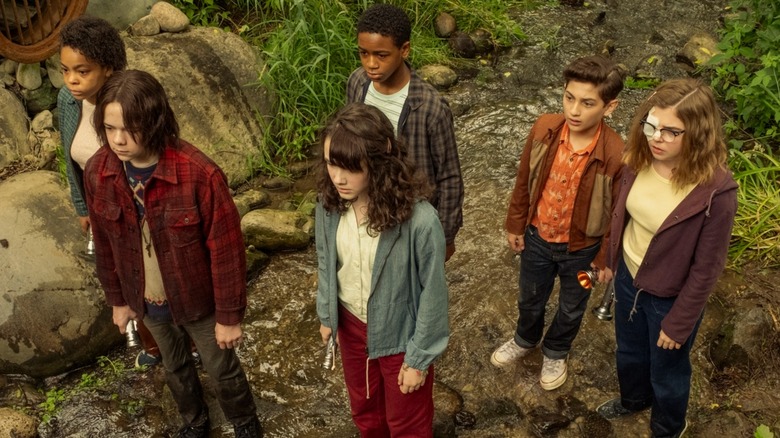
When the "Stranger Things" season 4 finale reached a point of no return, it left Hawkins forever changed, ominously splitting the Indiana town in half as the Upside Down began bleeding into our reality. This also implied that the townspeople would finally have to shed their obliviousness and realize that Hawkins has fallen prey to something unnatural. But the first four episodes of season 5 backpedal a lot to establish a sense of normalcy, with the good folks of Hawkins still being none the wiser. This doesn't make sense from a logical standpoint: Between the grisly child deaths and an apocalyptic event literally splitting their home apart, the townsfolk should be aware that something is amiss. Even if you suspend disbelief, it's hard to buy that nobody's ever noticed a demogorgon or two chasing a group of kids all over the town.
We see Hawkins under military-ordered quarantine in season 5, but this doesn't raise any major red flags for most folks, as life seems to be back to normal there. Indeed, if we compare the Hawkins situation with Derry in "It: Welcome to Derry," the townsfolk issue plaguing the former feels even iffier. Derry, of course, is no paradise — I would argue it's much worse than Hawkins, what with the shape-shifting Pennywise (Bill Skarsgård) being a constant threat, unlike the monsters of the Upside Down and their boss Vecna (Jamie Campbell Bower). Also, the children in Derry are mostly helpless, whereas Hawkins has the super-powered Eleven (Millie Bobby Brown) and her friends to protect it.
Derry is trapped in a cycle of violence and chaos that's in sync with Pennywise's feeding cycle, but most of its residents are complacent because they're by and large under the creature's control. But Hawkins is under no such spell, so what gives?
Hawkins still feels underwritten after five seasons of Stranger Things
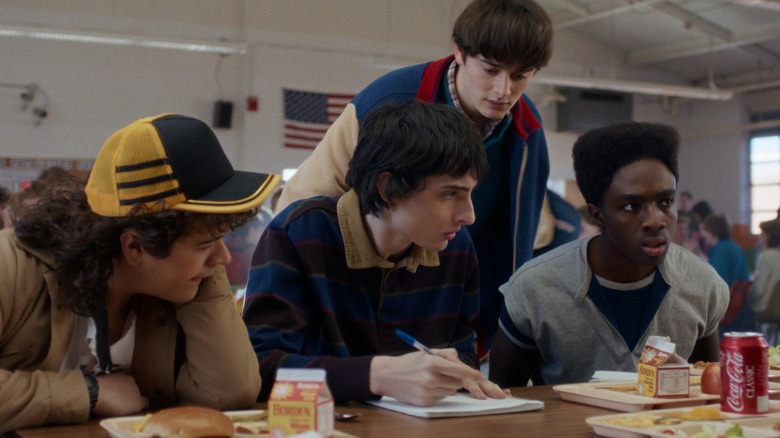
"It: Welcome to Derry" doesn't exist in a vacuum, as the stage has already been set by Andy Muschietti's "It" movies and Stephen King's vivid source material. Even so, the HBO series has painted a compelling portrait of Derry in only six episodes (at the time of writing), portraying the townsfolk as being extremely involved in the town's daily affairs despite their obliviousness to Pennywise. While the children experience the full brunt of the creature's terror, the adults aren't spared either, as they're encouraged by Pennywise to indulge in abject cruelty or bigoted behavior. No one's life is truly their own, but the veneer of normalcy is made possible due to Pennywise's eldritch powers. He can pull the most strong-willed folks inside concocted memories, unlock their darkest fears, and even turn lifelong friends against each other.
In Hawkins, the townsfolk exist as a backdrop and don't exhibit the nuance that one would expect from a small-town community. Hawkins is not a metropolis, which is why the apathy of its citizens doesn't make any sense. The disappearance of a single child should've been enough to shake the entire town, let alone the violent deaths of many. Instead, the people of Hawkins unjustly target a teenager, Eddie Munson (Joseph Quinn), after giving in to satanic panic, rather than trying to prevent any further deaths. And while this mob behavior is believable, none of the show's adult supporting characters feel like real people, which is an issue for a mega-hit series that's been going since 2016. Hopefully, the final episodes of "Stranger Things" will fix that.
"It: Welcome to Derry" is streaming on HBO Max. "Stranger Things" season 5, volume 1 is now available to check out on Netflix.