

You're Not A Denzel Washington Fan If You Haven't Seen His '90s War Movie
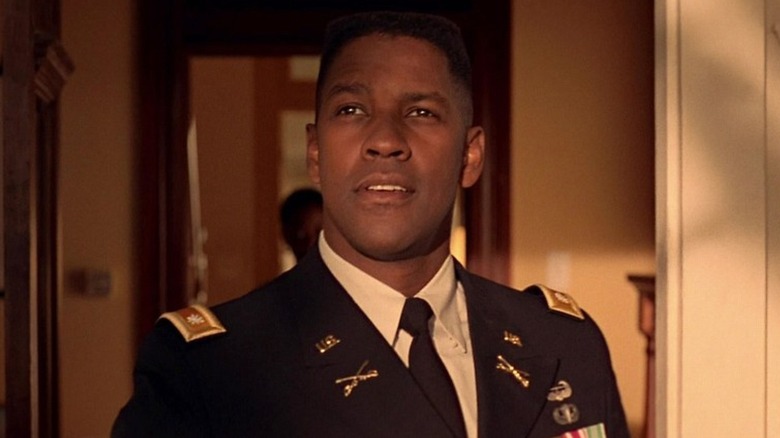
Edward Zwick's "Courage Under Fire," released in 1996, was the second time the director collaborated with star Denzel Washington. The first was their 1989 Civil War film "Glory," a notable hit and a memorable Oscar darling. "Glory" was nominated for five Academy Awards and won three, for its sound, for its cinematography (by Freddie Francis), and for Denzel Washington's performance. Although Washington was a notable Hollywood presence before "Glory," Zwick's film cemented his status as one of his generation's best actors. It stood to reason that Zwick and Washington would work together again.
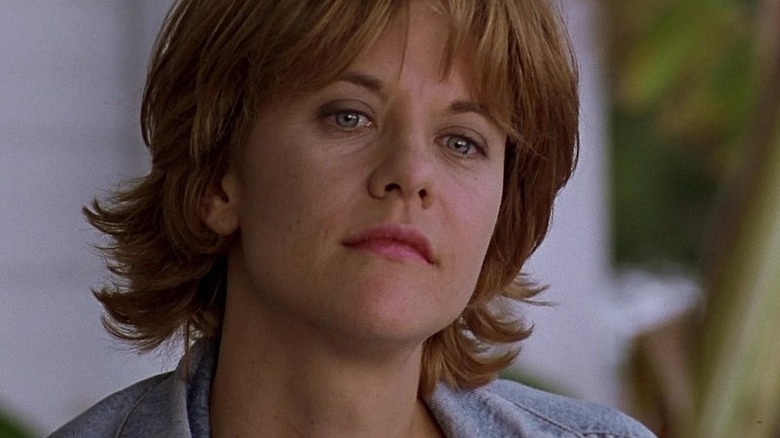
"Courage Under Fire" was another drama about the military, but this time, it surrounded the scandals and obfuscation involved with the war in the Persian Gulf during the George H.W. Bush administration. Washington played Lieutenant Colonel Nathaniel Serling, a man living with a secret. Years before, during the Gulf War, it seems Serling accidentally blew up one of his own tanks, killing a fellow officer. The matter was covered up, and Serling now works a military desk job. In this position, he is asked to determine the wartime valor of a fallen soldier named Colonel Karen Walden (Meg Ryan in flashbacks).
The film follows Serling's investigation into Walden's wartime actions. The story goes that Walden, a helicopter pilot, flew in to rescue a platoon of soldiers that was under enemy fire. She improvises an explosive in the heat of battle, and blew up an enemy tank. Her helicopter was shot down, however, and by the time a secondary rescue copter was dispatched, Walden had been killed. Walden stands to be awarded a Medal of Honor for her actions (she would be the first woman to be granted such an honor) ... until some conflicting testimony arises. Maybe, it's theorized, none of that is true.
Courage Under Fire is about the chaos of war
"Courage Under Fire" features a who's-who of notable stars. As the Serling character investigates, he gets "Rashomon"-like testimony from multiple other soldiers who were involved in the event. He talks to the angry and seemingly untrustworthy Monfriez (Lou Diamond Phillips), and the timid and quiet Ilario (Matt Damon). Other military characters are played by the likes of Sean Astin, Michael Moriarty, and Željko Ivanek. Scott Glenn plays a reporter, and Bronson Pinchot plays a White House aide. Throughout "Courage Under Fire," several conspiracies come to light, and Serling can readily recognize the hallmarks of a cover-up, seeing as he is also currently involved in one.
"Courage Under Fire," though, isn't about its conspiracy, really. It's very much about sexism in the military, and how doubt can easily be spread about a female soldier's fortitude in a battle situation. There is a lot of sexist banter about how women are too emotional to serve, and how her fear got fellow soldiers killed. The conflicting testimonies are re-enacted in conflicting flashbacks. In one rendition of events, Colonel Walden breaks down crying, whining about her nerves. In another, Walden cries, but only in relief, saying calmly that it was a mere nervous response. Meg Ryan gives a great performance in these flashbacks, enacting pretty much the same dialogue, but on very different emotional notes.
Washington is great as well (when is he not?), as he plays a generally honest character who has engaged in some unscrupulous activities. He is no hero. He is a complex person, and he understands that the fracas of combat can indeed lead to chaotic decisions that don't sound so cut-and-dry in retrospect.
War was deeply criticized in the 1990s

"Courage Under Fire" came out a year before Matt Damon won an Academy Award for writing "Good Will Hunting," when he was still best known for "School Ties." It was two years before he would play the title character in "Saving Private Ryan." He wasn't yet a "get." That he would become another Hollywood mega-star was a stroke of good casting on Zwick's part.
Zwick is an underrated filmmaker to be sure, often tackling difficult or complex notions and characters with an accessible Hollywood sheen. "Courage Under Fire" came at a rare time in American history when it wasn't directly involved in any notable wars, and the economy was booming. Clinton had just begun his second term in office, and there was a feeling in the air that we may have outlived the need for such conflicts. "Courage Under Fire," then, was timed just right to criticize U.S. war efforts as a corrupt endeavor. War, it argued, was always chaotic and never noble. Soldiers displayed grand acts of, well, courage under fire, but the government could not be trusted to recognize it. Their own sexist narratives were still part of the machinery.
"Courage Under Fire" isn't cynical enough for its punch to land indelibly hard, but it's slick and skilled enough to say its messages out loud. It wasn't widely seen, however. It's likely that audiences were still distracted by the supra-blockbuster "Independence Day," released only nine days earlier. Roland Emmerich's sci-fi actioner was about jingoistic patriotism, and was as corny as Kansas in August. With that flick floating through the air, maybe audiences didn't want to hear an indictment of the American military. A pity. "Courage Under Fire" is pretty good, with a strong Denzel Washington performance at the center of it.