

Oliver Stone's First Script For Conan The Barbarian Is Gloriously Outrageous

We may receive a commission on purchases made from links.
Cocaine is a hell of a drug.
John Milius' 1982 peplum flick "Conan the Barbarian" is a low-budget B-movie that somehow looks and feels like an A-picture. It has all the sex, violence, silly wizardry, and Dark Ages mayhem that a grindhouse-dweller might want, but its tone is downbeat and dramatic, giving the film a cinematic largesse that was lacking from the days of Steve Reeves. Conan is the creation of author Robert E. Howard, who penned about 20-some Conan stories throughout the 1930s. The character was always written as a pulp hero with violent tendencies and a penchant for sexual conquest, so Milius' approach was novel. Tell the pulp story, but give it careful, slick attention. Arnold Schwarzenegger played the titular character, a hero during the fictional "Hyborian Age," set shortly after the destruction of Atlantis, and he was the perfect choice.
Milius is credited as a screenwriter on "Conan" along with Oliver Stone. The latter, in 1982, had already started directing, having helmed "Seizure," and "The Hand." However, he was still four years away from his career-igniting hit "Platoon." Stone was also, by his own admission, heavily addicted to cocaine at the time. He wrote the screenplay for Brian De Palma's controversial 1983 crime epic "Scarface," a movie about a cocaine kingpin, and it was said to have been based on his own negative experiences with the drug. In James Riordan's 1994 book "Stone: The Controversies, Excesses, And Exploits of a Radical Filmmaker," Stone confessed that he wrote "Conan" while extremely high on drugs.
The legend goes that Stone's original script draft was way, way wilder than the film Milius ended up making. For example, Stone wanted "Conan the Barbarian" to take place in the distant future, and he pictured scenes where the warrior fights post-apocalypse mutants.
Oliver Stone's ideas for Conan the Barbarian were wild (and inspired by cocaine)
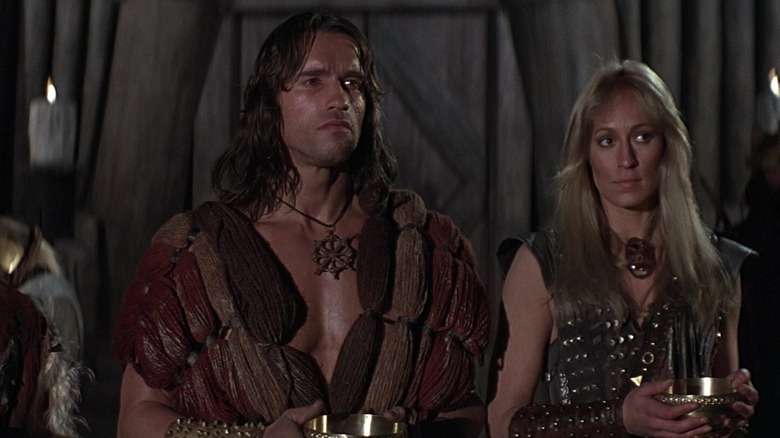
It should be noted that Milus' film isn't based on any specific Conan novel or story that Howard had already written; rather, it was extrapolated from the book series' general vibe. Stone had done his homework, and he wanted to base his script for "Conan the Barbarian" on Howard's books "Black Colossus" from 1933 and "A Witch Shall Be Born" from 1934. Both stories were originally published in the "Weird Tales" anthology magazine. "Black Colossus" is about Conan leading a small kingdom's army against the military forces of an invading wizard. "A Witch Shall Be Born" is about the witchy twin sister of the Khauran queen usurping her sister's place (which angers Conan, who is the captain of the queen's guard).
Milius is also quoted in Riordan's book, and it seems that Stone's script was amazing ... but also unfilmable. Milius described a script for a four-hour film, adding that it read like a fever dream. It was a fever dream the director liked, but it was still a fever dream. The plot was to involve Conan defending a beleaguered queendom, only from an army of mutants rather than a wizard or an invading military force. As Stone explained in Frank Beaver's 1994 biography "Oliver Stone: Wakeup Cinema," his early script draft for "Conan the Barbarian" was time-shifted forward many thousands of years to an unspecified post-apocalyptic period.
A coked-out, four-hour, post-apocalyptic version of "Conan the Barbarian" sounds spectacular, in a trainwreck sort of way. There's no doubt a film like that would bomb heavily at the box office. To repeat: Cocaine is a hell of a drug.
Cooler heads prevailed on Conan the Barbarian
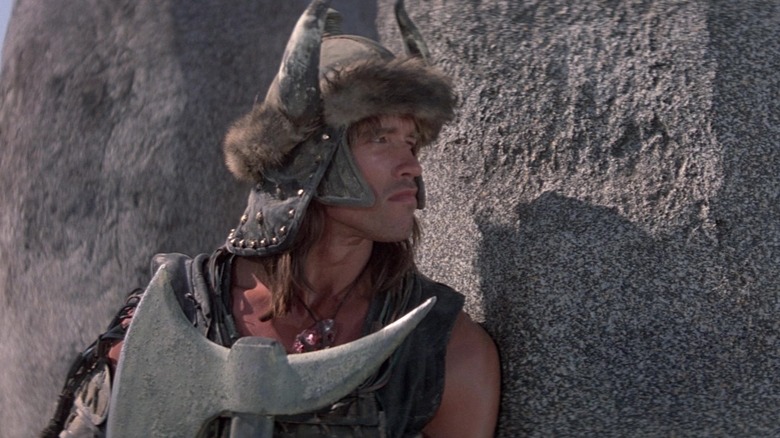
Thankfully, cooler heads prevailed. After Stone had finished his far-out script, Milius was brought on as director, and he essentially rewrote almost the entire project from scratch. Milius only retained an early crucifixion scene, along with a scene where Conan climbs the exterior of the evil wizard's castle. The rest was all Milius, inspired by a jumble of Conan stories, Japanese epics, and other mythic folk tales. "Conan the Barbarian" is a bouillabaisse of mythic influences that doesn't resemble any real culture's tales or historical period. If it feels authentic, one can credit Milius' direction and storytelling skills.
The film wasn't terribly well-liked by critics when it was released, with many feeling that it was transparently an adolescent sex-and-power fantasy. Also, and this is certainly true, the film is ridiculous. Conan is not a clever character by design, presenting as a taciturn and non-intellectual masculine ideal. "Conan" is not terribly healthy, but it is undeniably fun. Audiences certainly thought so, as the movie made over $79 million in theaters on a $20 million budget. It was followed by a sequel, Richad Fleischer's "Conan the Destroyer," in 1984. That film is a zanier yet somehow friendlier story about a ragtag group of misfits joining Conan on a quest to help a demure princess return a magical McGuffin to an evil demigod. It didn't do nearly as well at the box office.
The following year, Fleischer tried again with "Red Sonja," a film in the same spirit as "Conan." That movie also tanked, and the franchise went fallow until a 2011 remake. Of course, many now regard "Conan the Barbarian" as an action classic, so the time has come to go wild. Let's make another "Conan." Is Stone's script still out there somewhere?