

Why Test Audiences Hated Guardians Of The Galaxy's Drax (And How Marvel Fixed The Character)

We may receive a commission on purchases made from links.
When James Gunn's superhero caper film "Guardians of the Galaxy" was released in 2014, it was considered something of a risk. It was part of the ever-expanding Marvel Cinematic Universe, and while that series had already produced numerous giganto blockbusters, there was no reason to believe that "Guardians" would keep the ball rolling. Most notably, the characters were too obscure. Surprisingly, Gunn's impish humor seduced audiences, and "Guardians" proved to be as big a hit as many Marvel films. It became so popular, movie fans could now recognize obscure characters like Rocket Raccoon (Bradley Cooper) and Drax the Destroyer (Dave Bautista) on sight.
Drax was a fun character. A gray-skinned alien, Drax was the "muscle" of the group, happy to charge into battle and do damage with his bare hands. He came from a species that didn't speak in poetry or metaphors, and he didn't understand jokes or sarcasm. When Rocket declares that most of your jokes will go over Drax's head, Drax proudly declares that nothing can go over his head, as he would easily reach up and catch it with his lightning-fast reflexes.
According to Tara Bennett and Paul Terry's 2021 book "The Story of Marvel Studios: The Making of a Cinematic Universe," Drax was a difficult character to "crack." Gunn and screenwriter Nicole Perlman had envisioned the character as he is described above — as coming from a planet that doesn't have metaphors — but early test screenings left audiences cold on Drax. No one laughed at the character, and executive producer Kevin Feige couldn't understand why. They eventually figured out what was happening. In the initial cut of "Guardians," Rocket's speech explaining Drax was absent. Once it was written and inserted into the movie, audiences finally got it, and the character became clear.
Audiences didn't laugh at Drax until he was explained in dialogue
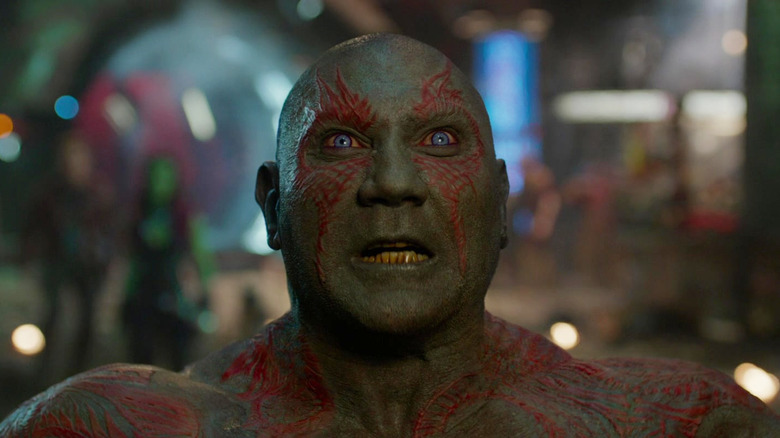
Feige was quoted in "The Story of Marvel Studios" as saying, "People didn't like him." Feige and director Gunn knew what he was all about and felt Drax was hilarious. They were baffled as to why audiences remained quiet during his scenes. Eventually, they figured out that Gunn had, essentially, disappeared up his own mythology. Gunn knew that Drax came from a planet that didn't understand metaphors, but no one else did. Feige told Gunn to communicate that directly to the audience, relating: "I said, 'We have to let the audience know that.'"
Gunn wrote and shot the scene wherein Rocket introduces Drax to several other characters, explaining that everything would go over his head. It was vital information. In a world as wild as "Guardians of the Galaxy's," clarity is key, and Gunn was forced to include it. "From then on," Feige said, "Drax killed because people got him."
Feige added, though, that Drax wasn't a vital to the functioning of "Guardians of the Galaxy" as Star-Lord, the film's central protagonist played by Chris Pratt. Star-Lord was a human abducted from Earth in the mid-1980s and raised by space pirates. His only totem from Earth was an old Walkman, loaded with a cassette of 1970s rock classics. Feige said that if audiences responded well to Star-Lord and grooved on the film's "Reservoir Dogs"-like playlist, then "Guardians" would function. "And they did," Feige said. "Right from the first screening."
Gunn made two additional "Guardians" feature films and a "Guardians" TV special before moving to Warner Bros. to work on a new superhero universe over there. His latest film, "Superman," was a modest hit in the summer of 2025.