

Martin Scorsese's Last '70s Movie Was An Absolute Disaster
We may receive a commission on purchases made from links.
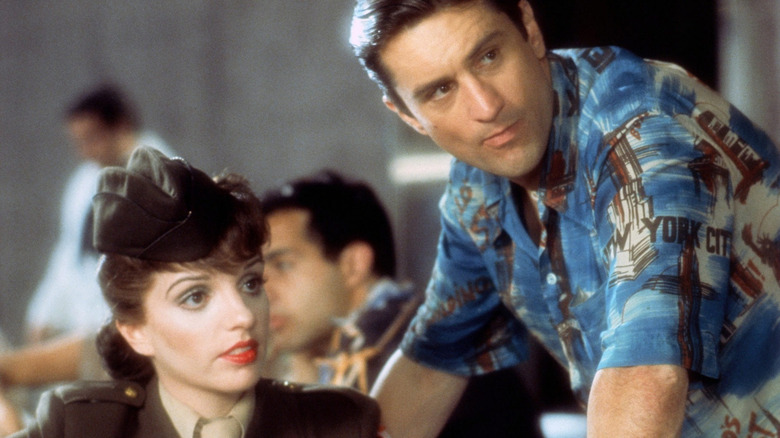
Martin Scorsese's 1977 musical "New York, New York" may easily be the director's worst film. It's too big, too ambitious, and way too long. Scorsese had hoped to make an old-world musical reminiscent of his 1940s favorites, but infused with his own naturalistic, almost documentary style. It's an interesting concept, but misguided on reflection. How can something be glitzy and shiny like an old-world musical while also being realistic? It didn't make sense. Scorsese was also fond of Robert Altman-style improvisation, and he allowed his actors to chatter and make up dialogue on the spot. This was a dangerous approach when filming on giant, expensive, and often unnecessary sets. Scenes go on and on and on without shape or, well, direction. The initial cut of "New York, New York" was over four hours long. Eventually, Scorsese shaved it down to a still-bloated 163 minutes.
As he confessed in Peter Biskind's seminal film history book "Easy Riders, Raging Bulls," Scorsese was addicted to cocaine while filming "New York, New York," and he was taking lithium to manage his mood. All the while — and this is a pretty open Hollywood secret — Scorsese was having a fling with his star, Liza Minnelli, much to the consternation of his then-wife. Even Scorsese feels it's a miracle that anything good came out of "New York, New York."
A lot of the disasters of the making of "New York, New York" were catalogued in a 2023 article by the Telegraph. The production was a mess, the film was a mess, and it bombed at the box office. Made for a then-large $14 million, it only earned an underwhelming $16.4 million in theaters. It's a good thing United Artists also made "Rocky" a year before that, as that film put it back into the black.
Scorsese's New York, New York kinda sucks
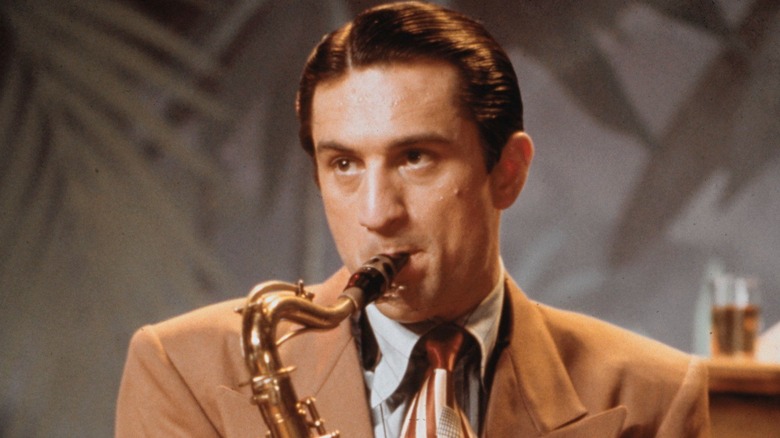
It should be remembered that Scorsese's cocaine addiction was quite serious. The filmmaker would end up in the hospital at age 34, having possibly suffered a brain hemorrhage. It was in this state that he felt he could make an enormous musical spectacle. Watching the film ... well, cocaine is a hell of a drug.
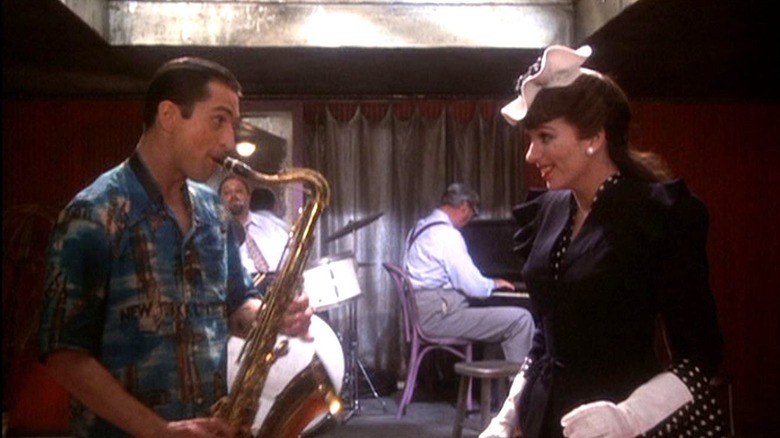
"New York, New York" is ostensibly a love story, but it's closer to a portrait of an abusive relationship. It begins in 1945 during a USO show, where the rough-hewn and badgering saxophone player Jimmy Doyle (Robert De Niro) sets his sights on a singer named Francine Evans (Minnelli). He doesn't so much charm her as he forces his way into her life. He also forces her to join him at an audition, during which the short-tempered Jimmy yells at everyone. When Francine sings to calm the room, the pair get a job as a traveling musical duo. This leads to a rushed marriage proposal, an unplanned pregnancy, and, ultimately, Jimmy leaving Francine behind. They both become hit musicians, and the film ends with them both contemplating reuniting. It's not the least bit romantic, largely because Jimmy is such a temperamental varlet.
One can see why Scorsese might have wanted to make something like "New York, New York," though. Up to that point, he had become synonymous with mean streets films like, well, "Mean Streets," as well as the controversial yet widely celebrated "Taxi Driver." He was a filmmaker celebrated for his grit and violence. What better way to diversify that career than with a musical? Scorsese wanted to prove he could do anything. Perhaps he did have a great musical in him, but "New York, New York" wasn't it.
Scorsese was inspired by A Star is Born
According to the Telegraph article, Scorsese took the original script for "New York, New York" (credited to Earl Mac Rauch and Mardik Martin) and completely rewrote it to highlight the romance between the two leads. He was reportedly inspired by the 1954 version of "A Star is Born," perhaps in part because that film starred Minnelli's mother, Judy Garland. "A Star is Born" is an alcoholism tragedy about two artists who find solace in one another, despite their depression and/or addiction. "New York, New York" has no addiction story at its center, so the drama isn't quite as moving.
The only addiction at hand was Scorsese's. His drug issues colored every decision on "New York, New York." Scorsese was pulled between Old Hollywood and New Hollywood, and he wasn't able to stylistically reconcile them on camera. He allowed De Niro to improvise wildly, really delving into Method acting. Minnelli is visibly uncomfortable on camera, however, and clearly not well-trained for improv. The two leads have such different acting styles that it basically kills any hint of romantic chemistry between them. Scorsese also went overboard with a lot of the musical numbers and in-film movies. One of them reportedly cost $350,000 by itself.
For the press tour, Scorsese didn't give any interviews because, by his own recollection, he had run out of cocaine. Without the drugs, he couldn't function. When "New York, New York" bombed, Scorsese withdrew from Hollywood for a few years. He wouldn't return until De Niro convinced him to make "Raging Bull" ... and to quit the drugs. Scorsese did both, and he made what is often considered one of the best films of the 1980s. After "New York, New York," it could only have been a step up.