

One Of Star Trek: TNG's Best Episodes Was Inspired By A Fuji Film Advertisement
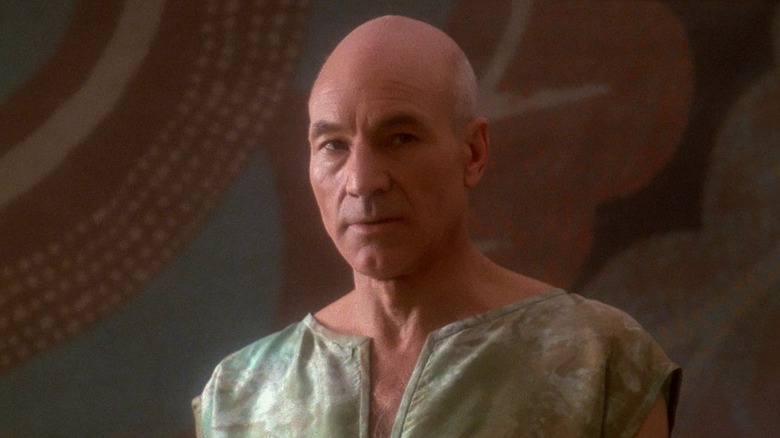
The "Star Trek: The Next Generation" episode "The Inner Light" (June 2, 1992) is often considered one of the show's best. In it, Captain Picard (Patrick Stewart) is zapped in the brain and knocked unconscious by a passing spatial probe, only to wake up on a distant alien world he's never seen before. Picard is told that he is actually a Kataanian named Kamin, and that his life as Captain Picard was only a hallucination. In actuality, Picard is passed out on the floor of the Enterprise, and his experiences on Kataan are hallucinations fed to him by the probe.
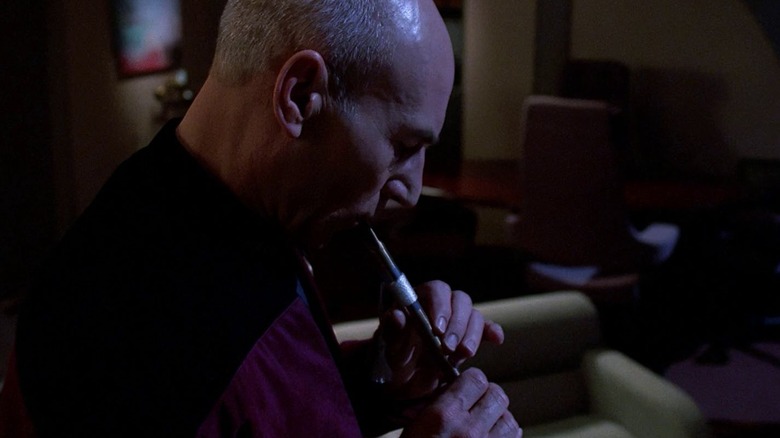
In real time, Picard only spends about 25 minutes unconscious. In his mind, however, decades pass. Picard accepts that he is actually Kamin, falls in love with his wife, fathers children, and grows into a very old man. He learns music, makes friends, and experiences all the nuances of Kataanian culture. When Picard awakens, he has to fight to remember that he was ever this "Captain Picard." It's a deeply emotional episode, with a tragic, wistful ending. There's a reason, you see, why no one on the Enterprise has ever heard of Kataan.
And the episode's screenwriter, Morgan Gendel, once said that he was inspired to write "The Inner Light" after seeing the Fuji Film blimp floating outside his apartment window. Back in 2017, Gendel was interviewed by Nerdist about "The Inner Light," and he revealed his thought processes, some behind-the-scenes details, and everything that was cut from the final draft. He also talked about the long development process and how he had to return to "Next Generation" producer Michael Piller five times, honing his pitch each time. More than anything, though, Gendel noted that the initial spark for "The Inner Light" was the notion that a floating probe could drift past you and beam an advertisement directly into your brain.
Screenwriter Morgan Gendel fashioned the Inner Light probe after the Fuji Film blimp
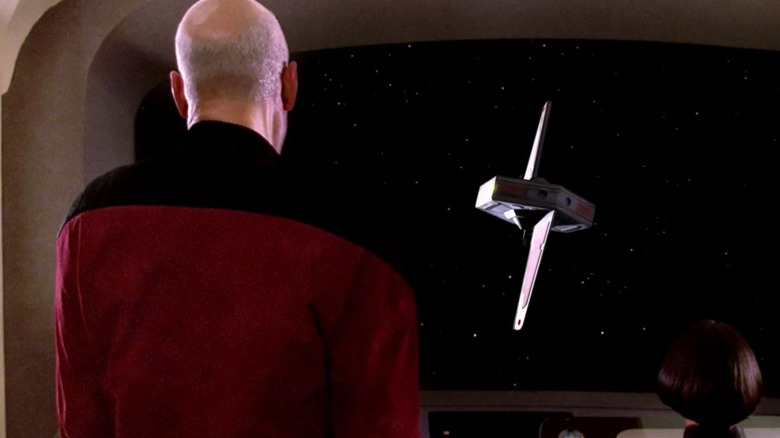
The idea of a probe beaming advertising directly into one's brain is a bleak notion, of course, and one that would be seen as monstrous in the post-capitalist utopia of "Star Trek," but transform the ads into a sentimental, 50-year domestic life, and it becomes grand and honestly felt. Gendel recalled the day the blimp flew by, though, and gave him the inspiration he needed to pitch a "Star Trek" story. He said:
"[Fellow writer] Joe Menosky made an appointment for me to pitch, so I was getting kind of desperate that I didn't have anything fresh or original. [...] But my youngest daughter was about to turn 2 years old. And I remember looking out her window and seeing the Fuji Blimp, which was a blimp that advertised film. So this thing looked very futuristic for the time, considering this is before digital even ... It was very futuristic."
The Fuji Film blimp, by the way, was similar in make and model to the famed Goodyear Blimp. Both airships would occasionally cruise the skies of Los Angeles, and it was an exciting event if you spotted one. At night, both blimps could activate light-up panels that would display advertising slogans and other inspiring messages. When it was dark, the blimps did indeed look like alien spacecrafts. Gendel continued:
"[M]y original concept was: what if the Enterprise comes across something very strange — like a probe — and next thing you know, Picard, Riker and Ro Laren would find themselves on another planet. And my concept was an ancient, yet futuristic, version of the Fuji Blimp, that could essentially advertise TV commercials right into your brain that would make you feel like you're living an experience."
That experience translated, in a roundabout way, to the plot of "The Inner Light." As we now know, Riker (Jonathan Frakes) and Ro Laren (Michelle Forbes) were eventually written out of the plot, making it a Picard solo story.
Morgan Gendel said that the tech elements of The Inner Light came first
Because "The Inner Light" is such a deeply emotional story, many might assume that Gendel conceived of it as a character piece for Picard. Picard, after all, had famously forgone a wife and a family to focus on his career as a starship captain. He was largely at peace with his decision, happy to live alone and work a stressful and edifying job to the utmost of his abilities, but he did occasionally express minor regrets in not developing the ability to grow close to people.
Gendel knew about this assumption, and shocked fans by revealing that, at least initially, he wasn't thinking about Picard at all. Every "Star Trek" story has an element of humanity and an element of science fiction embedded in it. Gendel merely began on the technological side of things to write "The Inner Light." He said:
"A lot of people thought that the impetus of this episode was Picard's whole 'the life not taken' emotional journey, but in this instance, the tech part of the story came first, before the emotional arc of Picard. Since then we've had a lot of 'theater of the mind' movies — like 'The Matrix' — but at the time there wasn't a whole lot of that."
In 1992, when "The Inner Light" aired, virtual reality technology was in a very rudimentary phase, and the idea of projecting your brain into an electronic simulation was the stuff of sci-fi novels and Philip K. Dick short stories. But V.R. was clearly on people's minds. Brett Leonard's "The Lawnmower Man" was released in theaters three months before "The Inner Light" aired, and a slew of cyber-thrillers were on its tail. Morgan Gendel was on the cutting edge of a growing trend.