

John Wayne Hated This Controversial Western With 91% On Rotten Tomatoes (For A Good Reason)
Movie violence has been a controversial topic since the very dawn of cinema. Some audience members panicked during the iconic sequence in "The Great Train Robbery" when an outlaw fires his pistol directly at the camera, thinking they were really under fire. Three decades later, Howard Hughes was forced to make numerous cuts to the violent scenes in "Scarface," earning it the reputation as "one of the most highly censored films in Hollywood history." Both movies look rather tame today, however, and we can trace the roots of more visceral and realistic screen violence to the late 1960s with Arthur Penn's "Bonnie and Clyde" and Sam Peckinpah's "The Wild Bunch." Despite all the hand-wringing that the films caused at the time with their gory shootouts, both are regarded as groundbreaking classics, and the latter even holds a very impressive 91% rating on Rotten Tomatoes. But the Western icon John Wayne who wasn't so impressed by Peckinpah's bloodbath, and he had an understandable reason for hating the movie.
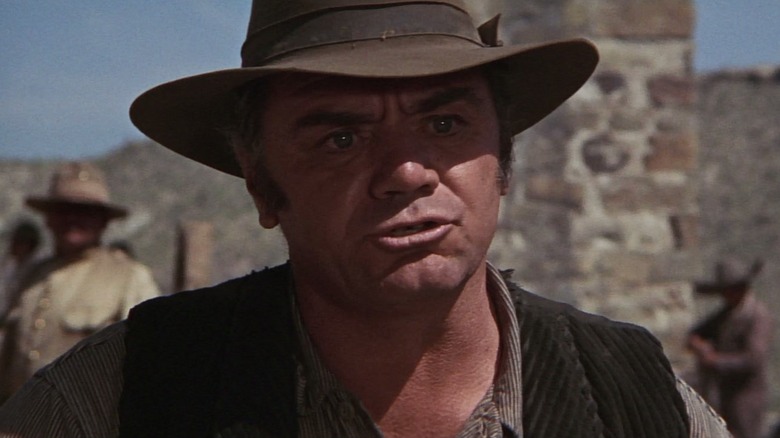
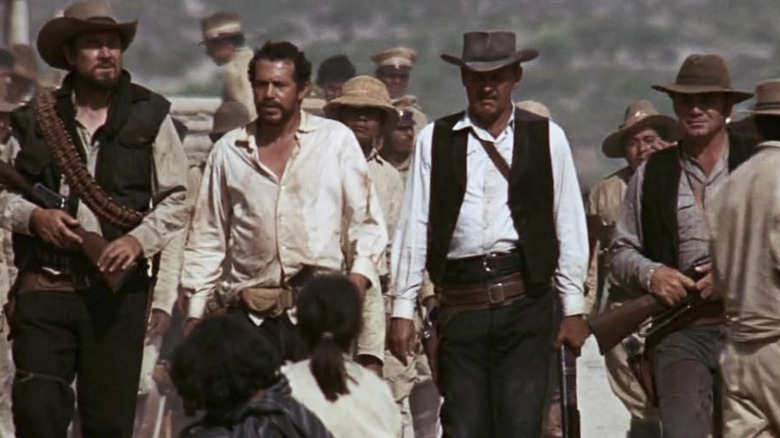
During his notorious interview with Playboy magazine in 1971, the Duke bemoaned the state of motion pictures and expressed relief that he wouldn't be around much longer to see the future of American cinema, taking aim at New Hollywood game-changers like "Easy Rider," "Midnight Cowboy," and Sam Peckinpah's elegiac masterpiece. Almost 60 years on, it's still easy to see why "The Wild Bunch" was so shocking. Set at the tail end of the Old West, it's the story of a gang of aging outlaws led by Pike Bishop (William Holden), desperate men trying to make a living in a changing world by the only way they know: violence. With Pike's former partner Deke Thornton (Robert Ryan) on their trail with his posse of equally brutal bounty hunters, the gang march out to meet their doom facing impossible odds against a corrupt Mexican general and his bloodthirsty troops.
Even by today's standards, the gruesome finale of "The Wild Bunch" is breathtakingly violent. Outnumbered and outgunned, Pike cuts loose with a Browning machine gun in a rhapsody of carnage, mowing down dozens of enemies before he and his cohorts die in a hail of bullets. The sequence took 12 days to film, using around 10,000 blood squibs and 300 edits to convey the sense of chaos. It was a true tour de force from Peckinpah, but it certainly wasn't to the Duke's taste.
John Wayne hated New Hollywood cinema as a whole towards the end of his career
John Wayne was approaching the final curtain when he sat down with the Playboy interviewer in 1971. His last movie, the Western "The Shootist," was released in 1976, and it provided a perfect send-off before Wayne passed away in 1979. From that standpoint, nearing the end of his life and career, it's understandable why a deeply conservative figure like Wayne would feel alienated by the harder edges of New Hollywood.
Emboldened by the collapse of the old studio system, filmmakers of the American New Wave no longer had to hold back in terms of sex, violence, profanity, and darker themes. It was a world away from the 1940s and '50s when Wayne rose to become one of Hollywood's biggest stars, and he naturally viewed the new era unfavorably compared to the good old days. He lamented the "hairy, sweaty bodies" in more explicit sex scenes and lambasted "Midnight Cowboy" as "disgusting," describing the central relationship with a particularly offensive homophobic slur. He also labeled "Easy Rider" as "perverted" and felt the blood and gore of "The Wild Bunch" was distasteful, claiming Peckinpah had gone too far. For Wayne, you didn't need to show graphic blood and guts to get a point across, harking back to the kind of violence in his own pictures. As he told Playboy:
"The violence in my pictures, for example, is lusty and a little bit humorous, because I believe humor nullifies violence. Like in one picture, directed by Henry Hathaway, this heavy was sticking a guy's head in a barrel of water. I'm watching this, and I don't like it one bit, so I pick up this pick handle and I yell, "Hey!" and cock him across the head. Down he went — with no spurting blood. Well, that got a hell of a laugh because of the way I did it. That's my kind of violence."
Wayne believed that the job of actors and filmmakers was to provide escapist illusion, not to show things how things truly are. I can sympathize with that to a certain extent, even if it is a bit naive and unrealistic — art doesn't exist in a vacuum and films will always reflect real life, especially in troubled times. On its own, a yearning for pure movie magic is a fair enough reason, but Wayne's interview also revealed his hypocrisy.
Is this the real reason John Wayne hated The Wild Bunch?
John Wayne was only 18 years older than Sam Peckinpah, but their contributions to the Western genre couldn't be much different. Peckinpah made his directorial debut with "The Deadly Companions," released the year before Wayne's final Western with John Ford, "The Man Who Shot Liberty Valance." The latter served as the passing of the torch from classic Hollywood horse operas to more cynical revisionist Westerns that interrogated the myth-making of the Old West — lore that the Duke and Ford had a big hand in popularizing in the first place.
"The Wild Bunch" obviously wasn't a Vietnam movie, but it was made as a direct response to the casualties in the Vietnam War. With young Americans dying on a daily basis, Peckinpah refused to show violence the old-fashioned way; when people died in battle, they didn't just clutch their stomach and bloodlessly fall to the ground. As such, Wayne calling "The Wild Bunch" distasteful was missing the point. Peckinpah intended the film to be as distasteful as possible, aiming to shake audiences from their apathy towards screen violence. Indeed, he later admitted that he went a little too far.
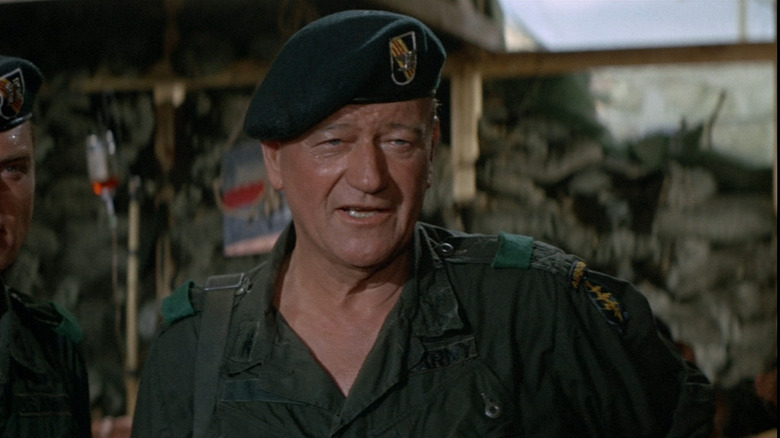
Wayne, on the other hand, supported a full-scale war in Vietnam, telling Playboy in the same interview, "I figure if we're going to send even one man to die, we ought to be in an all-out conflict. If you fight, you fight to win." Perhaps that was easy for him to say: Wayne never saw active duty, filing for draft deferral while other Hollywood stars like James Stewart, Clark Gable, and Henry Fonda all risked their lives in World War II. Furthermore, he did his bit to make sure the conflict in Southeast Asia continued. Dismayed by the wave of anti-war sentiment in the United States, he sought to bolster support for military action in Vietnam by co-directing the pro-war "The Green Berets."
The film hit theaters a year before "The Wild Bunch" and was a financial success. Critics savaged it, however, calling it an old-fashioned fantasy that did disservice to the troops laying their lives on the line thousands of miles away. Maybe that's the real reason Wayne hated Peckinpah's film — not only was it better received by critics, but it also shunned the myth of glorious sacrifice in battle and presented an inconvenient truth for pro-war figures like himself: Death in wartime is often ugly and brutal and final.