

Why Everyone In The Star Trek Franchise Speaks English, Explained
We may receive a commission on purchases made from links.
One of the most convenient pieces of technology in the "Star Trek" universe, from a writer's perspective, is the universal translator. Whenever two aliens from vastly distant worlds meet for the first time, they begin speaking, and they both miraculously speak the Queen's English. And it's not just screen-to-screen communication — a Starfleet officer can meet an alien face-to-face out in a remote wooded area, and they too will be speaking English. The universal translator is clearly something that everyone in "Star Trek" has implanted in their bodies. There are hardly ever communication issues having to do with language.
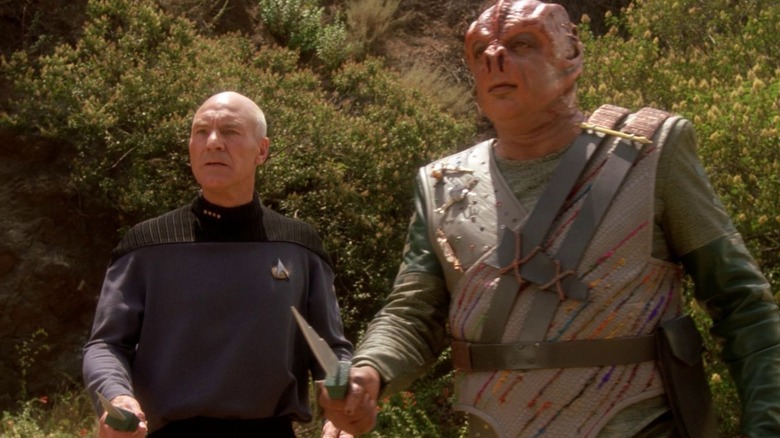
The "Star Trek" writers have found a few innovative ways to acknowledge universal translators from time to time. Famously, in one of the very best "Star Trek: The Next Generation" episodes, "Darmok," Captain Picard (Patrick Stewart) had to communicate with a Tamarian named Dathon (Paul Winfield), only to find that his species communicated almost exclusively in metaphor. The universal translator understood his syntax, but none of the cultural references.
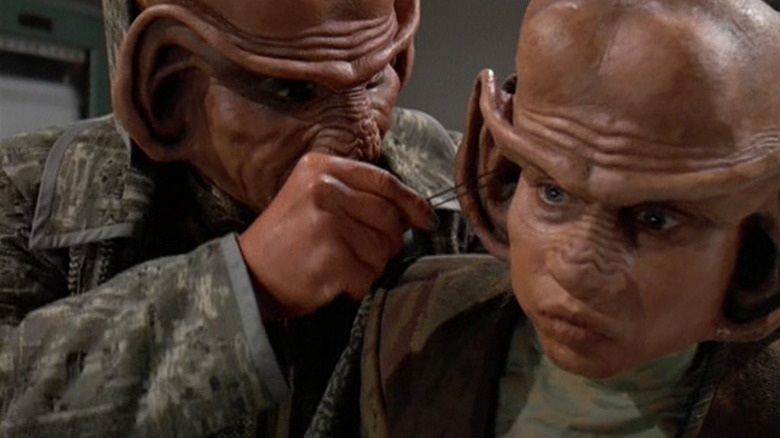
There have been a few other episodes wherein translators were an issue. In an episode of "Star Trek: Enterprise" called "Dawn," in which Trip Tucker (Connor Trinneer) crash-lands on a remote moon with an alien attacker (Gregg Henry), there aren't effective translators at hand, so they have to find new ways to communicate. In the "Star Trek: Deep Space Nine" episode "Little Green Men," Quark (Armin Shimerman) and his Ferengi family travel back in time to 1940s Earth, and initially have trouble communicating with the primitive humans. It's in that episode when it's first established that universal translators are implanted inside one's ears.
But for the most part, the universal translator just works.
The universal translator is a handy contrivance for Star Trek writers
The reason for the creation of the universal translator was discussed in Allan Asherman's invaluable 1988 book, "The Star Trek Interview Book." Writer Jerry Sohl, who authored the original series episode "The Corbomite Maneuver," mentioned that he and the other writers were kicking around the idea of a wrist-worn translation device. It was forward-thinking of Sohl to address the problem of alien languages so early in the franchise's run. "But we got rid of that idea," he said, "and assumed that everybody did speak English." In short, no one was going to worry about it. It's like artificial gravity on the Enterprise: We just accept that it's there, and it always magically works, even if it's not mentioned a lot.
Of course, accepting that there's a universal translator in "Star Trek" means we also have to accept its many inconsistencies. It's never been explained, for instance, if the universal translator automatically scans a visiting ship's entire linguistic database before the captains begin communicating. If it does, it seems like that would be an invasion of privacy. Most noticeably, every alien speaks English, and their mouths always seem to be pronouncing English words. Is the universal translator also projecting a holographic English-speaking mouth over an alien's lips? That part has never been explained. It wouldn't be until the 2016 movie "Star Trek Beyond" that an alien would mouth her native language while an English-language translation played at a higher volume over her.
The existence of the universal translator also raises the question: Are all the frequent "Star Trek" characters speaking the same language? Is it possible that Sulu (George Takei) has been speaking Japanese this whole time, and his words were just translated? Is Captain Picard only speaking French?
Who is speaking what language?
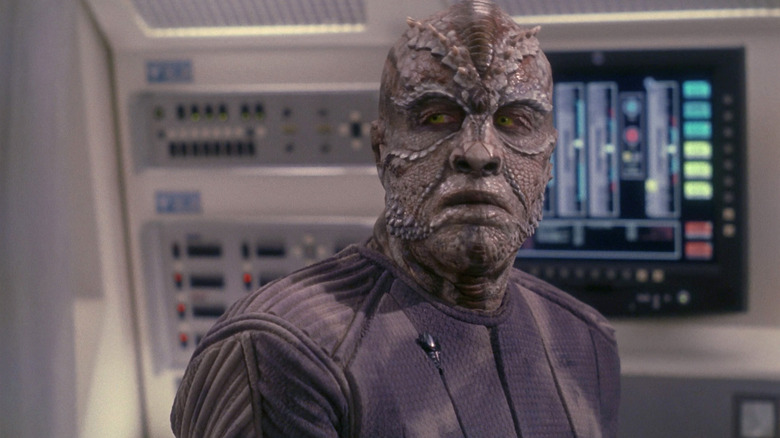
A few details about the universal translators have popped up periodically throughout the 60-year history of "Star Trek." In the movie "Star Trek VI: The Undiscovered Country," it was stated that Klingon ships are able to detect when such translators are being employed, forcing Uhura (Nichelle Nichols) to speak Klingon in person. Luckily, she and the Enterprise crew had some very old Klingon dictionaries –printed on paper! — that they were able to hastily reference.
There were a few instances, too, when the universal translator didn't work too well. It took a few minutes for it to catch up with the Skrreean language in the "Deep Space Nine" episode "Sanctuary," for instance. In the world of "Star Trek: Enterprise," set a century before the events of the original "Star Trek" universal translators were still in their rudimentary phase, and the ship required an actual language expert on staff in the form of Hoshi Sato (Linda Park). She could use a universal translator, but also did most of the translating herself. In that series, Ferengi were seen using universal translators that they held in their hands. That might have been a nod to the wrist-mounted widgets that Jerry Sohl thought about so many years before.
Of course, the existence of the universal translator hasn't stopped "Star Trek" from going the extra mile every so often. Linguist Marc Okrand, for instance, created an entire syntax and vocabulary for the Klingon language, and many characters speak Klingon on camera throughout the franchise. Sometimes we'll hear phrases in Vulcan or Ferengi. If an alien speaks in clicks or underwater hums, the showrunners will handily provide subtitles. But the distinction between subtitles, alien language, and English is a choice of convenience.