

Why Steven Spielberg Rejected The Planned Indiana Jones Horror Movie
One could easily make the argument that the Indiana Jones movies are partially horror films. The movies all feature gruesome deaths and center on a hero (played by Harrison Ford) who kills without remorse. Fans of these films have crunched the numbers, and Indiana Jones directly kills upwards of 50 people in "Raiders of the Lost Ark," "Indiana Jones and the Temple of Doom," and "Indiana Jones and the Last Crusade" alone. For comparison, Jason Voorhees kills 34 people across "Friday the 13th Part 2," "Friday the 13th Part III," and "Friday the 13th: The Final Chapter" (via Gamespot).
(In fairness, Indy only kills people who are actively trying to kill him, but the point still stands.)
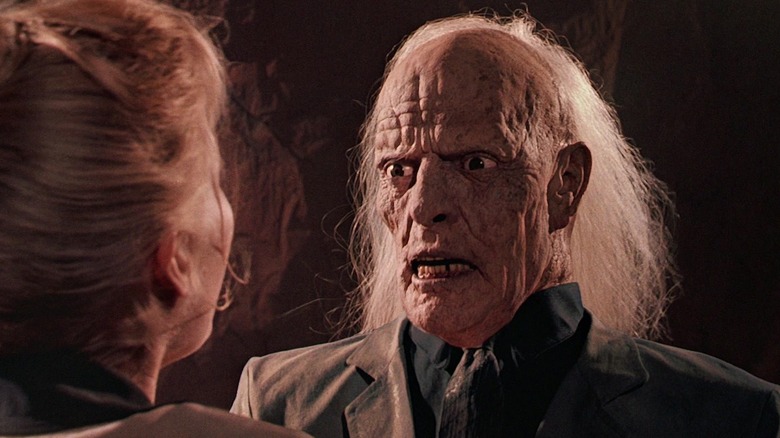
Additionally, people die in horrible ways in the "Indiana Jones" movies. The villains who open the titular "Lost Ark" are all melted or blown up by the power of God. A sacrificial victim similarly has his heart magically ripped from his chest in "Temple of Doom" right before being dropped into a lava pit, while Walter Donovan (Julian Glover) prematurely ages into a skeleton in seconds in "Last Crusade." Steven Spielberg, who directed the first four "Indiana Jones" films, has a great eye for the horrifying, as he's shown time and time again. That extends to 1982's "Poltergeist," a haunted house movie that he produced, co-wrote, and held a lot of creative control over. Tobe Hooper, however, is the film's credited director.
Nevertheless, as documented in Paul Bullock's 2017 oral history of "Temple of Doom," Indiana Jones creator George Lucas once pitched the concept for an Indiana Jones horror movie set in a haunted castle in Scotland. Spielberg turned down Lucas' idea, though, having just worked on "Poltergeist."
George Lucas once pitched an Indiana Jones movie set in a haunted castle
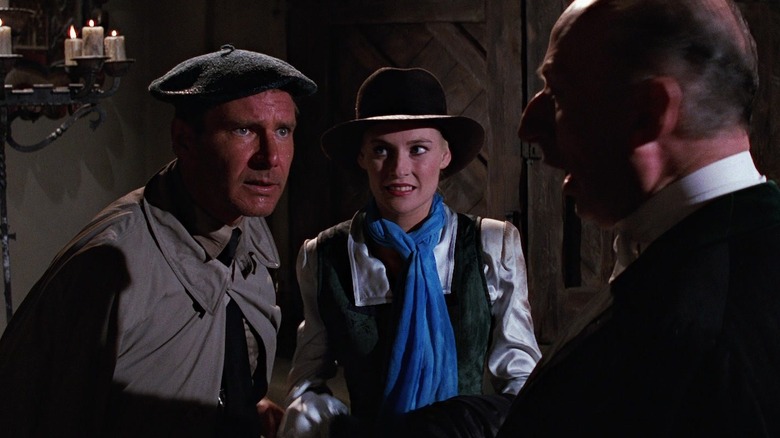
1981's "Raiders of the Lost Ark" was, famously, a huge hit with both critics and general audiences alike. So, because the film was inspired by old-timey adventure serials from the 1930s, it stood to reason that a sequel would be made. Eventually, Steven Spielberg directed 1984's "Indiana Jones and the Temple of Doom," a movie set a few years before "Raiders." Before that, though, George Lucas had a lot of ideas for Indiana Jones films, one of which involved the deity known as the Monkey King (via Empire).
Eventually, Lucas came up with the notion of a film about Indiana Jones dealing with malevolent spirits in a haunted castle in Scotland. As Lucas recalled (per Paul Bullock's oral history):
"The original story was about a haunted castle in Scotland. But Steven said, 'Aww, I just made 'Poltergeist,' I don't want to do that again.' And that's when we started working with Bill Huyck and Gloria Katz [on 'Temple of Doom']."
Willard Huyck and Gloria Katz (who had previously co-written Lucas' breakout 1973 hit "American Graffiti") are the credited screenwriters on "Temple of Doom," a movie that's set in 1930s India and involves a dangerous supernatural Thuggee cult that engages in human sacrifice, enslaving children, and assorted dark magic. It has a pretty bleak story, so much so that it scared away "Lost Ark" writer Lawrence Kasdan.
"The story ended up being a lot darker than we intended it to be," Lucas admitted. He continued:
"Part of it is that I was going through a divorce at the time, and I wasn't in a good mood; and part of it was that we wanted to do something a little bit more edgy."
Steven Spielberg didn't really want to make Temple of Doom
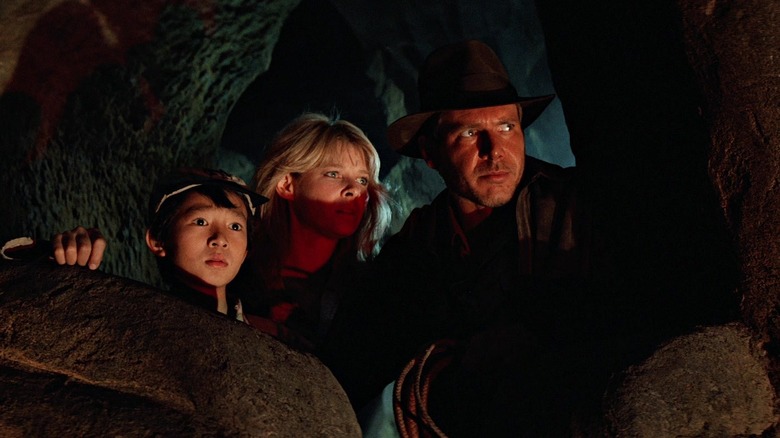
Steven Spielberg, it should be noted, didn't really have his heart in making "Indiana Jones and the Temple of Doom." He may not have wanted to direct a horror movie featuring ghosts, but "Temple of Doom" was as horrific as anything. However, it wasn't based on any burning personal desire to tell this particular story. Since then, Spielberg has even confessed that "Temple of Doom" is his least favorite "Indiana Jones" film, going so far as to say:
"I wasn't happy with 'Temple of Doom' at all. It was too dark, too subterranean, and much too horrific. I thought it out-poltered 'Poltergeist.' There's not an ounce of my personal feeling in 'Temple of Doom.'"
Keeping that in mind, Spielberg didn't need to be in a foul mood to make a dark movie. In fact, he had already directed several horror or, at the least, horror-adjacent projects prior to "Temple of Doom," mostly at the start of his career. He began his professional directorial career by helming the "Eyes" segment of the 1969 "Night Gallery" TV series pilot, which is bleak and scary. After that, he directed the rather terrifying 1971 feature "Duel," which follows a man who, while driving on remote desert highways, finds he is being hunted by a mysterious semi truck. Spielberg even helmed the 1972 TV movie "Something Evil," a flick that straight-up involves demons.
And, of course, Spielberg has directed a few creature features that you might have seen. His shark movie "Jaws" had a little bit of blood in it, while his dino-bonanza "Jurassic Park" has several people being savaged by prehistoric monsters. Spielberg has stayed away from horror in recent years, but he certainly has it in him.