

Nicolas Cage Helped Make One Of The Most Underrated Vampire Movies Ever
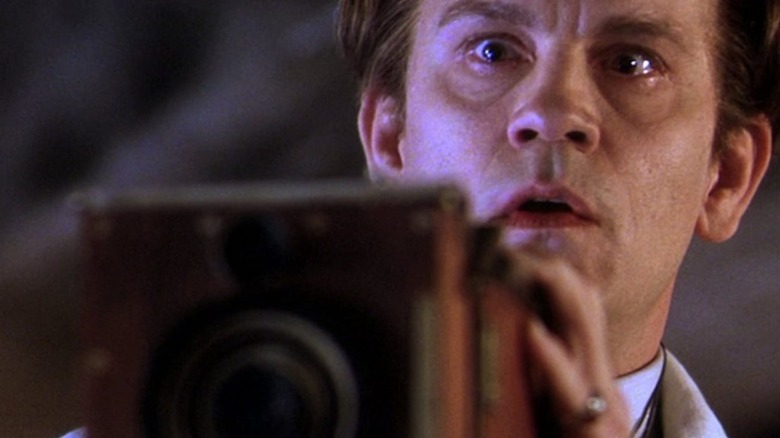
The premise of director E. Elias Merhige's 2000 film "Shadow of the Vampire" is weirdly believable. It posits that filmmaker F.W. Murnau, when he was making the landmark 1922 horror movie "Nosferatu," was so committed to cinematic realism that he located and hired an actual vampire to portray the vampire in his movie. In actuality, the star of "Nosferatu" was a German actor named Max Schreck, but Schreck's stiff, monstrous, rat-like performance as the vampiric Count Orlok was so convincing that it doesn't take much imagination to buy that he was actually a vampire.
In "Shadow of the Vampire," Murnau is only able to wrangle his vampire performer with the promise that he will be allowed to drink the blood of the movie's star, Greta Schröder, once production has wrapped. Naturally, though, the vampire isn't able to control himself and kills a few of the picture's crew as shooting commences. Murnau, however, is merely annoyed that his filming schedule is being interrupted.
Murnau was played by John Malkovich, who easily captures the creative frustrations of a film director, while Willem Dafoe received an Oscar nomination for playing Max Schreck/the vampire. Merhige's film also featured Suzy Eddie Izzard as the dull leading man Gustav von Wangenheim, Cary Elwes as the cinematographer Fritz Arno Wagner, Udo Kier as the producer Albin Grau, and Catherine McCormick as Greta Schröder. The film was widely acclaimed when it was released, and film buffs love its rewriting of cinema history to include at least one real vampire. In addition to Dafoe's Oscar nomination, it was also up for Best Makeup.
What many readers may not know is that "Shadow of the Vampire" was produced by Nicolas Cage. It was only the actor's second producing credit after the little-seen Christopher Coppola film "Bel Air."
Nicolas Cage produced E. Elias Merhige's Shadow of the Vampire
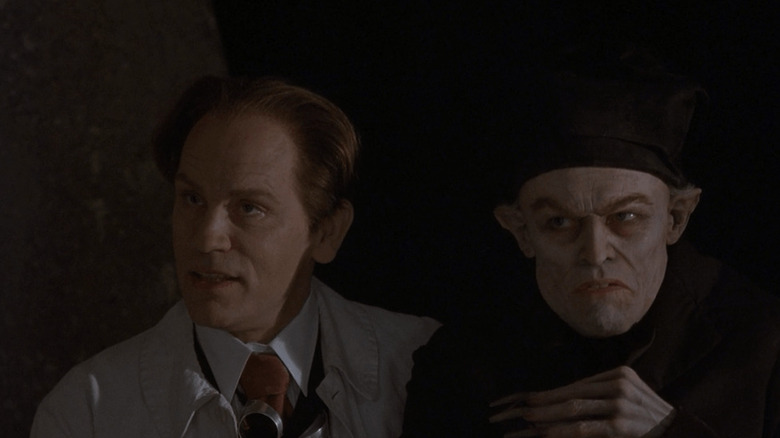
"Shadow of the Vampire" only made about $11.2 million at the box office against its modest $8 million budget, but it was deeply beloved by film students everywhere (at least by the ones I went to film school with), and it is still highly regarded to this day. E. Elias Merhige had previously helmed the 1989 cult film "Begotten," and his sensibilities skewed more in the direction of abstraction and myth than traditional Hollywood storytelling, so it's no wonder his Hollywood career didn't last long. After his feature follow-up, "Suspect Zero," he went back to making abstract experimental horror short films, notably "The Din of Celestial Birds" in 2006 and "Polia & Blastema: A Cosmic Opera" in 2022. It's been reported that his next film, "Howl," is currently shooting in Calgary.
Nicolas Cage, meanwhile, was just starting a new facet of his career with "Shadow of the Vampire." He had barely launched his new production company, Saturn Films, and began taking control of his own productions. Saturn Films also handled 2003's "The Life of David Gale" and the 2012 Eddie Murphy comedy "A Thousand Words," but it's mostly been used to house Cage's own movies. It's since produced Cage's directorial effort "Sonny" and several of his starring vehicles, including "Next" (a Philip K. Dick adaptation), "The Family Man," "Lord of War" (which used real guns!), "Knowing," "National Treasure," and "The Sorcerer's Apprentice," as well as more recent films like "Arcadian," "Willy's Wonderland," and "Longlegs." Cage has always been a devoted actor who is capable of turning in supremely zany performances, so he seems to be a good match with Merhige, an eerie poet of the highest order.
Shadow of the Vampire is really great
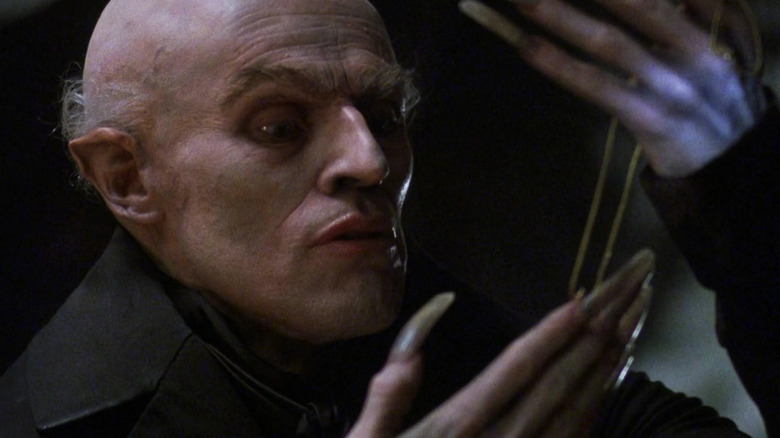
It's a pity that Nicolas Cage and E. Elias Merhige have never re-teamed, as "Shadow of the Vampire" is an excellent film. "Nosferatu," meanwhile, is one of the most famous horror films ever made, and it still terrifies a century after its production. It's also miraculously available despite a notorious legal dispute involving the Bram Stoker estate (the real F.W. Murnau essentially ripped off Stoker's classic vampire novel "Dracula" without permission by making "Nosferatu") and has become something of a German national epic, as evidenced by Werner Herzog remaking the film in 1979 with Klaus Kinski.
There was also, of course, Robert Egger's jazzed-up rendition of "Nosferatu" in 2024, which starred Bill Skarsgård as the vampire. That film pretty much just accentuated the original film's themes of sexual repression, repackaged with some striking, smoky visuals and some truly scary performances.
"Shadow of the Vampire" may be considered a footnote to these official remakes, but it's actually one of the more faithful echoes of Murnau's original. It's about art and the struggles therein, as well as the dark phenomenon of a movie director putting their cast and crew in danger, all in the name of being considered a "daring artist." This is a film about a filmmaker who hires a literal predator, which should ring especially loudly to audiences watching in the post #MeToo era of the 2020s.
"Shadow of the Vampire" can be rented online at the Prime Video store, but it's sadly not available to stream for free on any service at the moment. Some resourceful internet sleuths may be able to find it online, however, and it's certainly worth a look. It's one of the best vampire movies of all time.