

Guillermo Del Toro's Toughest Movie To Make Was Also A Major Box Office Bomb
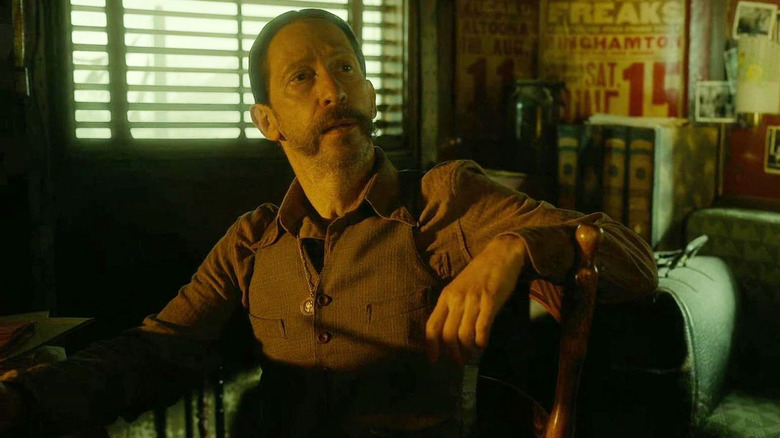
Directed by Guillermo del Toro, 2021's "Nightmare Alley" is the second film adaptation of William Lindsay Gresham's 1946 novel after the 1947 movie version starring Tyrone Power. It came with a wave of Oscar buzz upon its release, sporting some amazing production design, a long and twisty script, and crackerjack performances by Bradley Cooper and Cate Blanchett. Its director, a master stylist, always preferred the idea of his mythic tale of carnivals, murder, and hypnotists being in monochrome, so he eventually released a black and white rendition of his own take on "Nightmare Alley."
In the end, del Toro's "Nightmare Alley" received four Oscar nods (Best Picture, Best Cinematography, Best Costume Design, and Best Production Design), but it didn't win any. Nevertheless, it has an 80% rating from critics on Rotten Tomatoes, with /Film's review declaring del Toro's carnival noir "stylish as hell."
The 2021 "Nightmare Alley" tells the story of Stanton Carlisle (Cooper), a man who, near the start of the film, is destitute and takes a job at a traveling carnival. He ends up charming one of the carnival's young performers, Molly (Rooney Mara), but his time with the carnival ultimately comes to a dark and deadly end. However, using the crowd-manipulating mentalist skills he acquired there, Stan teams up with Molly to become a star mentalist himself.
Although "Nightmare Alley" is full of blood and melodrama, it didn't draw huge crowds. Made for a sizable $60 million, del Toro's film only grossed roughly $39.6 million at the box office (and that includes ticket sales from the black-and-white version). It's a pity, too; speaking to Empire Magazine in 2021, he admitted that "Nightmare Alley" was the most difficult movie he had ever directed up to that point in his career.
Nightmare Alley was, well, a nightmare for Guillermo del Toro to direct
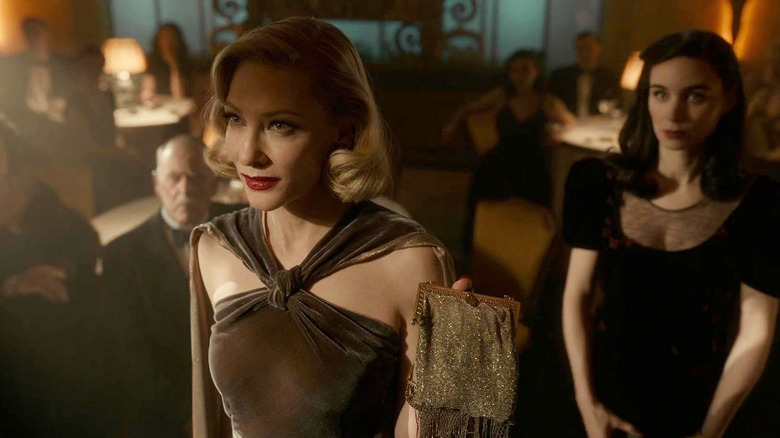
Guillermo del Toro didn't mince words about his experience making "Nightmare Alley," and it's easy to see why. The film is a 150-minute odyssey, with the above plot summary really only covering the first quarter of the movie, and it delves beyond the world of carnivals to evolve into a dangerous film noir about seduction, mentalism, and murder. Oh yes, and alcoholism. Alcohol is a big part of the movie.
Also, del Toro famously likes to make a lot of genre experiments. He's directed several horror movies, but also three superhero films, a Hollywood creature feature, a monster-themed romance, three Spanish-language fantasies that stand as political commentaries, and a straight-up kaiju flick. And really, it was the rapid cycle through genres that gave del Toro the most consternation. As he told Empire:
"This is, bar none, the most difficult movie I ever made. 'Pan's Labyrinth' was similar, in that you don't know if you're going to be able to complete — or even survive — it because so much is against it. But then — that's when you grow [...] When I went from 'The Devil's Backbone' to 'Blade II,' I called my agent and said, 'Please get me out of here. They're gonna fire me in the first week. I am not an action director.' And my agent said, 'Well, become one.' And I thought, 'Yeah, why not?'"
The world's many fans of "Blade II" — a Marvel movie about a vampire hunting superhero — would agree that del Toro certainly succeeded. "The Devil's Backbone," meanwhile, was a ghost story about the echoes of war at a remote orphanage. It was quite a head-spinning switch.
Nightmare Alley was a box office bomb, but Guillermo del Toro is doing fine
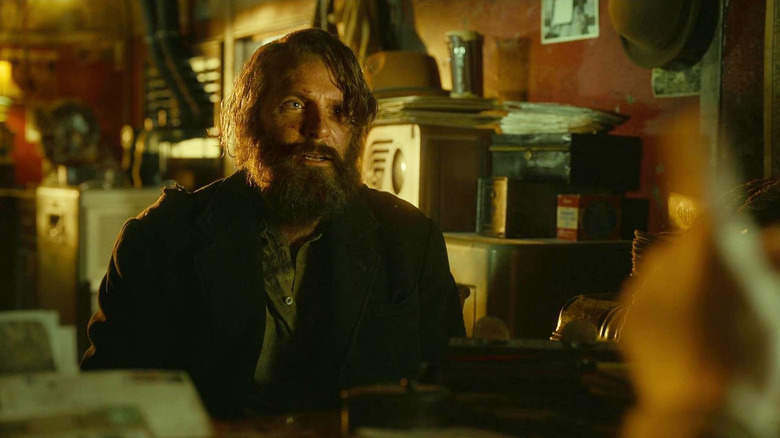
Guillermo del Toro continued, remarking that film noir was not a genre he had tackled as a director prior to "Nightmare Alley." As such, he was reminded of his experiences when he set to work on "Blade II," noting:
"Coming into 'Nightmare Alley,' I had to use tools and instincts that were new — I had to be a noir, drama director — but in a career that can encompass 'Pacific Rim' or 'Pan's Labyrinth,' well, I just decided: 'I'll become one.'"
He may have effectively become a film noir director, but he wasn't a successful one (commercially speaking, anyway). As mentioned, "Nightmare Alley" bombed at the box office, likely in part because it was released when theaters were still being slowly reopened after the quarantine era of the COVID-19 pandemic. It didn't help that it was also a R-rated movie targeted at adults, which have generally struggled at the box office in general since 2020. Meanwhile, the same day that "Nightmare Alley" hit theaters, the Marvel ultra-blockbuster "Spider-Man: No Way Home" premiered on its way to bringing in roughly eleventy skatillion dollars. ($1.92 billion, to be exact.)
Whichever way you cut it, del Toro's sinister little noir flick didn't stand a chance. His next directorial effort, "Pinocchio," debuted on Netflix one year later and won the Oscar for Best Animated Feature Film, while his latest film at the time of writing, 2025's "Frankenstein," is currently up for a handful of Academy Awards, including Best Picture. Box office be damned, del Toro is still beloved.