

Guillermo Del Toro's '90s Sci-Fi Flop Got A Near-Perfect Score From Roger Ebert
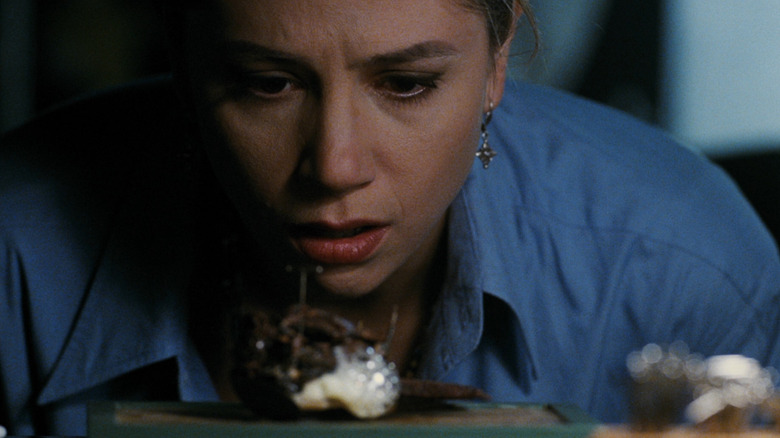
"Mimic" hit theaters late in the summer of 1997. It was Guillermo del Toro's second feature-length directorial effort after his debut on the acclaimed 1992 vampire flick "Cronos," as well as his first movie fully in English. Based on "Mimic," the world wouldn't have been able to predict that its director would go on to become a beloved cult icon and legit Hollywood darling in subsequent decades. As of this writing, his films "Pan's Labyrinth," "The Shape of Water," "Nightmare Alley," "Pinocchio," and "Frankenstein" have all won or at least been nominated for high-profile Academy Awards. He, like Tim Burton before him, is the rare monster-loving, elaborate-production-design-oriented oddball who's somehow broke through to the Hollywood mainstream.
"Mimic" was an unusual stop on del Toro's path, as it somewhat recalls Terence H. Winkless' 1988 killer cockroach movie "The Nest." Based on the short story by Donald A. Wollheim, "Mimic" is about a strain of disease-carrying New York cockroaches that, early in the film, are eradicated by a geneticist named Dr. Tyler (Mira Sorvino). She uses genetic tinkering to accelerate their metabolisms, causing them to starve to death. Three years later, however, she finds that accelerating cockroach metabolic processes also accelerated their ability to breed. In three years, the cockroaches have managed to cycle through thousands of generations, evolving with each one. By the time Dr. Tyler finds them again, the cockroaches are human-sized and even seem to have developed human-like internal organs. Creepy.
Audiences didn't care about "Mimic," and it flopped at the box office. Critics didn't think much of it, either (see: its 67 percent rating on Rotten Tomatoes), feeling it was merely a generic monster thriller. Roger Ebert, however, loved it, giving "Mimic" three-and-a-half stars and noting that del Toro had a visual style that elevated his film.
Roger Ebert recognized Guillermo del Toro's visual skills in Mimic
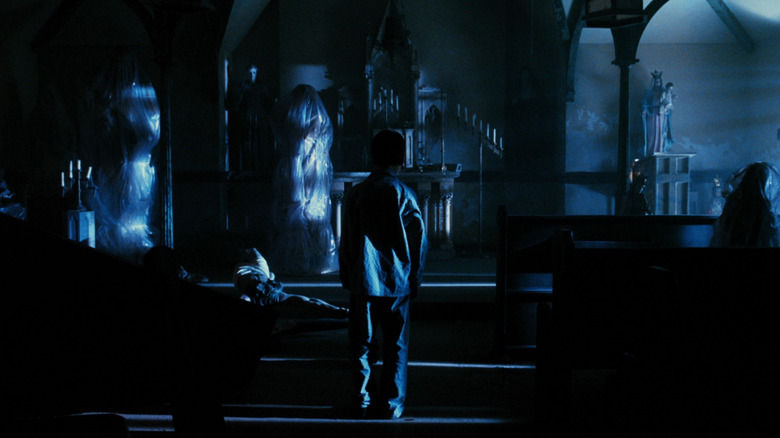
In his review, Roger Ebert noted that the screenplay for "Mimic," as written by Guillermo del Toro and Hollywood legend Matthew Robbins, was pockmarked with the usual trappings of the monster movie genre. Indeed, Ebert began his write-up by arguing that "Mimic" was essentially the same film as other then-recent horror movies like "Event Horizon" and "The Relic," in that they were all about people unwisely creeping down darkened corridors while some ineffable monster stalks and kills them one by one. He observed that in such movies, the monster — explained by the thinnest forms of pseudoscience — "leaps out of hiding at [victims] in ways long known to special-effects technicians."
But then, Ebert recognized that the ambitions of "Mimic" were far from the realm of breaking new ground. Clearly, del Toro wanted to make an old-fashioned creepy thrill-ride flick that wasn't so much different from its genre neighbors as simply better. As Ebert put it:
"'Mimic' is superior to most of its cousins and has been stylishly directed by Guillermo del Toro, whose visual sense adds a certain texture that makes everything scarier and more effective. It's not often that a movie like this can frighten me, but I was surprised at how effective 'Mimic' is. [...] This is all pretty standard stuff. Originality is in the details."
Ebert added that he actually liked the scenes where people recklessly stick their hands into dark holes, allowing a bug to bite them (something he remembered from "Cronos" a few years earlier). He also appreciated the moments where kids explore the dark tunnels of New York City looking for bugs and especially Chuy (Alexander Goodwin), a character who clicks spoons together to imitate the clicking of the bug monsters.
Mimic also has a great cast
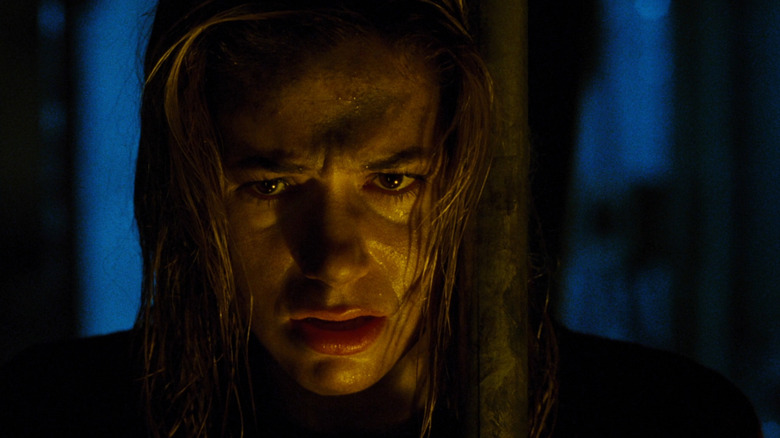
Moreover, "Mimic" features an all-around impressive cast. Mira Sorvino's onscreen husband is played by reliable British actor Jeremy Northam, while Josh Brolin portrays Northam's youthful assistant. In addition, F. Murray Abraham plays Sorvino's old mentor, with Charles S. Dutton portraying a streetwise security guard. Also keep an eye out for Norman Reedus and Italian star Giancarlo Giannini. In addition, "Mimic" was the first time Guillermo del Toro worked with Doug Jones, who played one of the monsters. The pair have since collaborated on several other occasions. However, the film marked the first and last time that del Toro worked with disgraced producer Harvey Weinstein, as they scuffled during its production.
Ebert concluded his review by writing:
"Del Toro is a director with a genuine visual sense, with a way of drawing us into his story and evoking the mood with the very look and texture of his shots. He takes the standard ingredients and presents them so effectively that 'Mimic' makes the old seem new, fresh and scary."
Notably, del Toro also included a creepy autopsy scene in "Mimic," and it would become a motif that he would repeat in films like "Blade II," "Frankenstein," and "Pacific Rim" (kinda). The dude loves to slice open dead monsters.
Other critics were vaguely positive on "Mimic" as well. Carol Buckland, writing for CNN, felt that it was nice and squirmy and contained enough creepy cockroach images to startle most audiences. Reviewing the film's director's cut for IGN in 2011, however, R.L. Shaffer found "Mimic" to be derivative. While del Toro may be a stylist, Shaffer estimated that he was mostly cribbing from David Cronenberg and Ridley Scott on this movie. On the whole, then, Ebert was the outlier who was actually enthused about "Mimic."