

Jurassic Park's T-Rex Was Transformed Into A Dragon For A Cult '90s Fantasy Movie
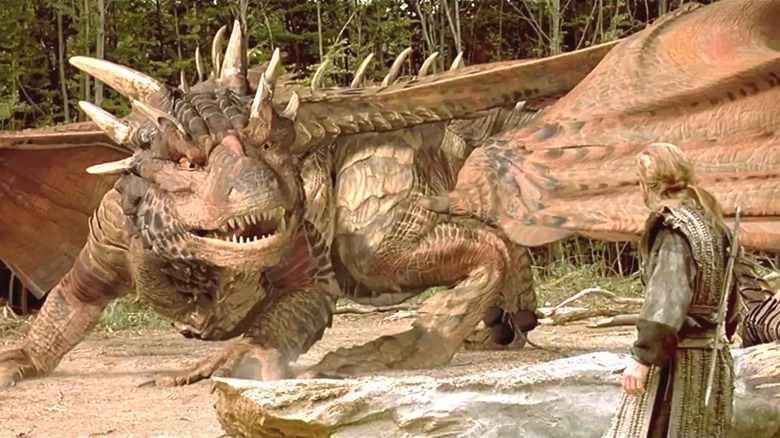
Rob Cohen's high fantasy film "Dragonheart" caused a minor stir when it was released back in the spring of 1996. It was something of a hit, making over $115 million on its pretty hefty $57 million budget. The reason it cost so much to make likely had a lot to do with its extensive use of CGI effects. In the film, Dennis Quaid played a medieval knight named Sir Bowen who had once sworn to slay every last dragon in his kingdom. He became too good at his job, however, and fell into alcoholism after he realized he pretty much wiped out the species singlehandedly. His final target was a dragon named Draco, a bitter and sarcastic creature voiced by the late, great Sean Connery. "Dragonheart" was the first time some viewers had seen a fully animated CGI character convincingly interacting with a human actor.
It should be noted that the CGI used to realize Draco was honed in the 1990s, meaning those shots look kind of dated today. Regardless, the film still has its fans. "Dragonheart" is light and fun, and the banter between Quaid and Connery is irresistible. The film was notable enough to receive an Academy Award nomination for its VFX (it lost to "Independence Day"), and it spawned several straight-to-video sequels in 2000, 2015, 2017, and 2020. Yep, they're still making "Dragonheart" sequels.
Back in 2016, the ILM-employed VFX technicians for "Dragonheart" were interviewed by Cartoon Brew as a celebration of the movie's 20th anniversary, and they revealed all the details about Draco's designs, his movements, and where a lot of his digital assets came from. Surprisingly, it seems many of the assets for the early screen tests for Draco were borrowed directly from the T-rex models constructed for Steven Spielberg's "Jurassic Park."
The early models for the Dragonheart dragon were repurposed assets from Jurassic Park
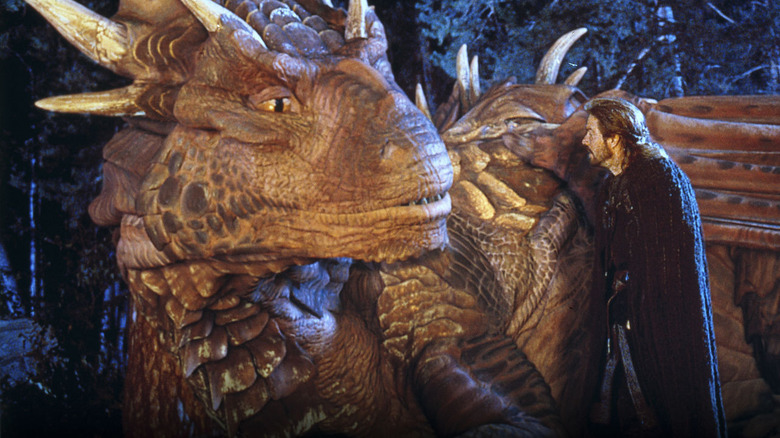
Keep in mind, this was years before the likes of "Star Wars: Episode I — The Phantom Menace" and "The Lord of the Rings: The Two Towers." Draco was weirdly important in the development of Hollywood CG effects, showing that semi-seamless CGI characters were possible. Scott Squires, one of the VFX supervisors on the film, was working for ILM, which worked on early VFX development on "Dragonheart." He said, "One of the tests they'd done was taking the dinosaurs they'd built for 'Jurassic Park' and making the lips move." Imagine the CGI T-rex from "Jurassic Park" speaking with Sean Connery's voice, and you have a rather amusing picture in your mind.
Paul Giacoppo, the lead digital character modeler for "Dragonheart," added that "they had animated a T-rex to make him talk with blend shapes and put pterodactyl wings on it to make it look like a crude dragon." The animators were essentially mixing and matching existing visual assets to see if they could animate a dragon properly. Co-supervising character animator Rob Coleman explained that ILM didn't have any dragon animation assets yet, so this "Frankenstein" approach was necessary. Once they put together the winged, lip-moving T-rex, they were able to animated it to some pre-recorded dialogue. Once that was done, designs on the final dragon could finally begin.
The final dragon design was provided by effect guru/animator Phil Tippett, who worked on animation or VFX for films like "Star Wars," "Dragonslayer," "Donsaur!," "Howard the Duck," "RoboCop," and "Willow" before working on "Dragonheart." (Tippet later directed the stop-motion animated film "Mad God," one of the best films of 2022.)
Phil Tippett designed the dragon for Dragonheart
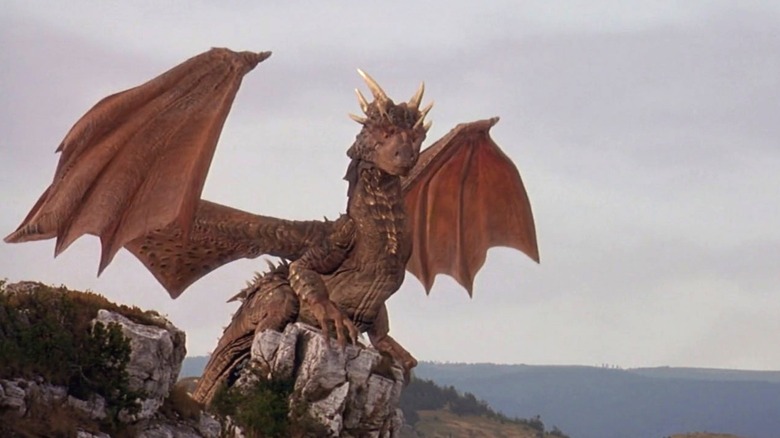
Phil Tippett even commented on his designs, saying they were kind of easy, given that he had already made multiple dragons and dinosaurs in his career. In Tippett's words:
"By the time we did Draco we had some experience with dragons — Vermithrax, the Eborsisk — and a lot of experience with dinosaurs, so we were in good shape. Draco was the first dragon we'd ever done that would be speaking like a human. We had to make a dragon that didn't look like all the other dragons, plus give the animators something they could work with to accomplish what the script called for."
Vermithrax is a reference to Vermithrax Pejorative, the central dragon from Matthew Robbins' 1981 fantasy film "Dragonslayer." That dragon was realized using a cool animation technique called go-motion, which was like stop-motion, but with a realistic camera blur added to make it look more natural and convincing. The Eborsisk, meanwhile, was the name of the two-headed, fire-breathing dragon from Ron Howard's 1988 film "Willow," which was also made with go-motion animation. The designs for Vermithrax were more "fantasy novel" classical, while the Eborsisk (apparently named after film critics Roger Ebert and Gene Siskel) was unique. Draco is very different from both, having more human qualities, and a more toyetic "pewter miniature" look to him. Naturally, Rob Cohen gathered up a huge book of reference photos of Sean Connery, as to give Tippett and his team some expressions they could build from.
The result was a pretty impressive accomplishment. "Dragonheart" has way more dragon effects than "Jurassic Park" had dinosaurs. It's an interesting and dazzling visual effects time capsule.