

Sylvester Stallone's Best Action Movie, According To Himself
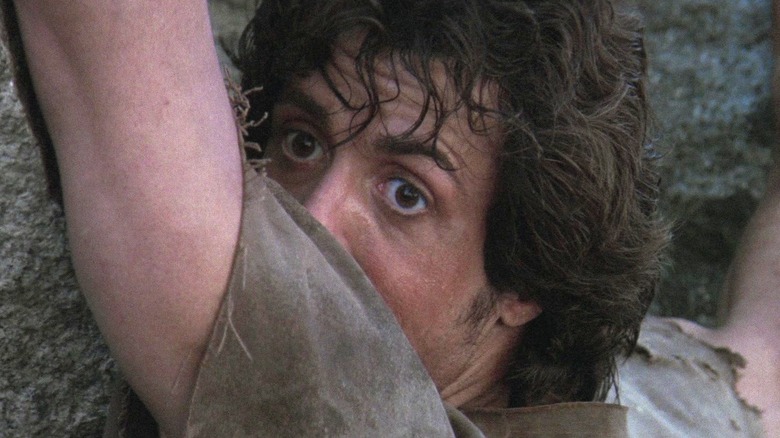
Every time I think about Sylvester Stallone's character John Rambo, I become astonished. Rambo first appeared in Ted Kotcheff's 1982 drama "First Blood," and he was presented as a quiet, gentle, wounded figure, weighed down by melancholy, saddened that his Vietnam War buddies had all died from Agent Orange exposure. He was the last surviving member of his platoon, something he learns at the beginning of "First Blood." Rambo walks into town, on foot, and ends up speaking to his buddy's widow. He is rudderless, his life destroyed by war. His skills at murdering people in the jungle have eroded his soul.
One can then immediately look ahead to 1985's "Rambo: First Blood Part II," which was a big, dumb, sweaty action film full of explosions and battlefield murders to overstimulate the brain. "First Blood Part II" isn't melancholy about Rambo's plight, but celebrates his battlefield capabilities. It's a gung-ho, jingoistic, pro-military shoot-em-up. It also made over $300 million at the box office, more than twice as much as its predecessor. Rambo went from a tragic figure to being a badass symbol of American military might and overwhelming imperial power. It was a blockbuster lie. Stallone appeared in three additional Rambo movies after 1985, with each one getting increasingly violent and, in some cases, increasingly stupid. ("Rambo: Last Blood," the most recent film, was ranked last in a ranking by /Film.)
Ask Stallone, though, and he still prefers the first. Indeed, Stallone recently spoke with GQ, who asked him to break down his most famous roles, and the Hollywood mogul said "First Blood" remains his best action movie — although his definition of the phrase "action movie" has more to do with acting technique than with fights and explosions.
Sylvester Stallone thinks First Blood is his best 'action movie'
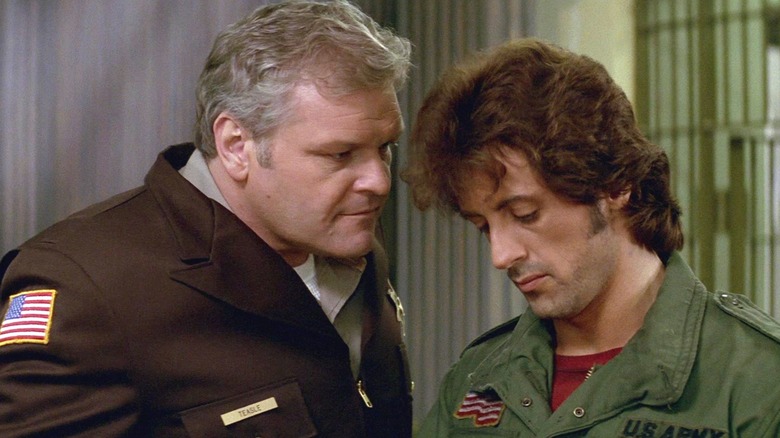
Thinking back to "First Blood," John Rambo is a taciturn character. He cannot verbally communicate too well. The implication is that Rambo has been so traumatized by the Vietnam War that he's partially lost his ability to speak. Stallone gives a rather subdued performance, telling the audience just who Rambo is with a look, with a gesture, with the movement of his body. It's a very, physical, action-forward performance. In the GQ interview, Stallone argues that, because Rambo is a person who speaks through his actions — both subtle and violent — "First Blood" could be considered one of the best "action" movies there is. He said:
"Inadvertently, I'd consider ['First Blood'] the best action film I've ever done. And I think it might be one of the first, when you say 'pure' action films. You've had car chases. You've had gunfights. But I mean, it's all action. You're speaking with your body, your looks, your intentions, and the other characters are doing the dialogue. You are in action the whole time."
Stallone explained that the original draft of the "First Blood" screenplay depicted John Rambo as a homicidal maniac with PTSD, who gleefully killed children in the war. The plot would have been that Rambo escaped military execution, and his old general (the Richard Crenna character in the final film) had to track him down and kill him. Stallone didn't like that story, and elected to re-write the script (he has a co-writing credit). Stallone's idea was to infuse the screenplay with a little hope, explaining that Rambo tries to avoid fighting at all costs. It was only the town's egocentric sheriff (Brian Dennehy) that pushed Rambo and prodded him until his old, violent "war mode" was reactivated.
Stallone feels that John Rambo was on the spectrum
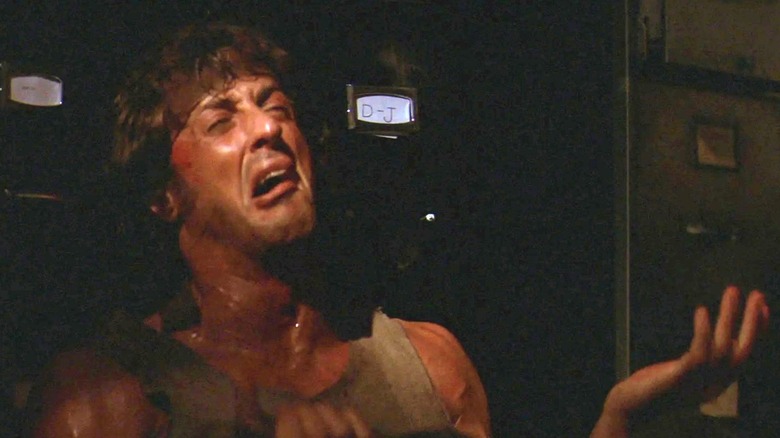
At the end of "First Blood," Rambo is confronted by the Crenna character and he breaks down. Rambo wails and cries, horrified that he slipped back into soldier mode so easily, and that he committed acts of violence against the sheriffs of this small town. He screams in agony about his horrible experiences in the war and how it broke him. He saw his friends blown up, and he thinks about it every day.
Stallone felt that Rambo's inability to cope, and his trouble speaking his emotions aloud, came from the character being on the autism spectrum. He delivered his final speech with that in mind. Rambo was already broken by the war, but he was also never given the help he needed to properly process his feelings. Stallone said:
"Once I got to do the re-write, and he has that speech at the very end, I did a lot of research. And it's almost a fellow who has been autistic. It's pouring out. It's disjointed. It's a manifestation of his complete breakdown, his loss."
Most of the nuances of "First Blood" vanished in the explosive haze of "Rambo: First Blood Part II," however. By the frustratingly titled "Rambo III," the character had completely changed. The movies continued to make money, and Stallone, as mentioned, revisited the character repeatedly over the decades. But "First Blood" remains intense, sad, and emotional in a way that most action films aren't. It's not defined by its mayhem or by Rambo's ability to kill. "First Blood" is a very political film, and it's odd that the politics took a complete 180 for "Part II." That canceled Rambo sci-fi sequel would have been just as appropriate.