

Before Spider-Man, Tobey Maguire Starred In An Underseen Fantasy Flop With Reese Witherspoon
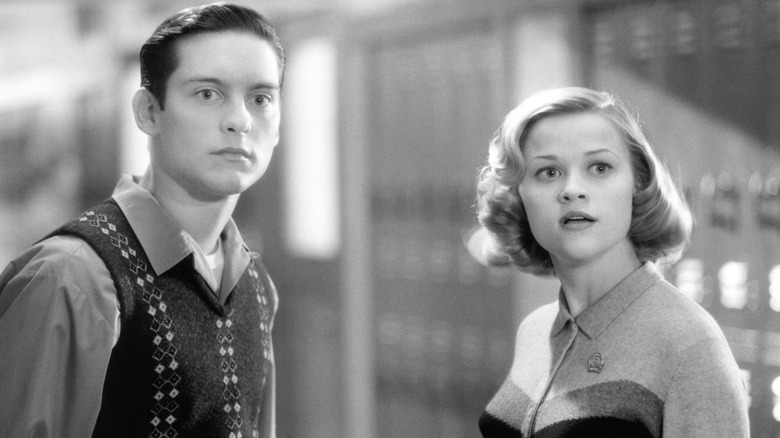
In the late 1990s, American media took a keen interest in deconstructing its own past. Many films and TV shows came out that savaged the conservative ideals of 1950s suburban Americana, revealing that there was angst underneath, and an aching cry for freedom coming from each of its denizens. The Reagan era was dead, and the placid aspirations of white, upper-middle-class professionals proved to be a pack of lies.
One can see these themes of cultural dissatisfaction in Sam Mendes' 1999 film "American Beauty," a film that delved into the rich suburbs to reveal racism, homophobia, violence, and artistic souls longing for an outlet. Heck, one can see these themes in "The Brady Bunch Movie," a film that transposed a 1970s TV family into the 1990s without changing their style or personalities. In the 1990s, po-faced, ultra-wholesome sitcoms seemed backward and comedic, their characters now seemingly from another planet.
One can especially see these themes in the Gary Ross film "Pleasantville," a widely beloved but little attended box office bomb from 1998. "Pleasantville" was about a modern teen named David (Tobey Maguire) who was obsessed with an "Ozzie & Harriet"-style 1950s sitcom called "Pleasantville." As the title of the show implies, nothing bad ever happened in Pleasantville. Everyone was friendly, and life was repetitive and calmingly predictable. David loves to watch reruns of "Pleasantville" and get lost in the nostalgia for a "simpler" time of 1950s post-war suburban bliss.
The twist occurs when a magical remote control zaps David and his snippy, horny sister Jennifer (Reese Witherspoon) into an episode of "Pleasantville." Like an inverse of "The Brady Bunch Movie," "Pleasantville" explores what would happen if '90s teens lived in a 1950s TV world. Oddly enough, everyone is in black-and-white. There will be color soon enough.
Pleasantville deconstructs misplaced nostalgia for the 1950s
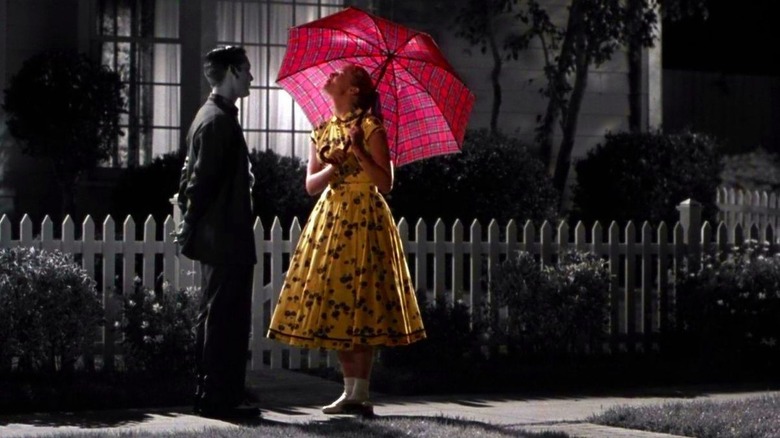
David and Jennifer see right away that they are in black-and-white, and the first act of "Pleasantville" is a strange meta-comedy about the mechanics and peculiar physics of living in a sitcom world. For instance, because toilets were never seen on camera on the 1950s "Pleasantville" sitcom, there are no toilets in town. If David doesn't appear in the right malt shop at the right time every day, the malt shop owner (Jeff Bridges) won't know to stop cleaning the counter. If one walks to the end of Pleasantville, they are magically transported back around to the other end. And, notably, no one knows what sex is in "Pleasantville." 1950s TV was, of course, notably sexless.
Of course, 1990s teens in such a place begin to introduce new elements, almost unwittingly, into the 1950s. Jennifer begins making out with Pleasantville's high school basketball star (a pre-"Fast and Furious" Paul Walker), and he begins seeing color for the first time. She also introduces her sitcom mom (Joan Allen) to the idea of sex and teaches her how to masturbate. When Mom achieves her first orgasm, a tree outdoors bursts into colorful flames. David begins falling in love with a local girl (Marley Shelton), and she finally seems to feel love in return. She becomes colorful as well.
David begins to fret that Pleasantville is becoming too colorful, but also finds that passion, intellect, rage, deep and earnest emotions, expressed openly in public, are making the world a more vivid place. Gary Ross is clearly telling a story of how America's obsession with 1950s post-war idealism (a notion that often surges up in right-wing circles) is misplaced. It's nostalgia for a time when repression and passionless lives were the words of the day.
Pleasantville wasn't a hit, sadly
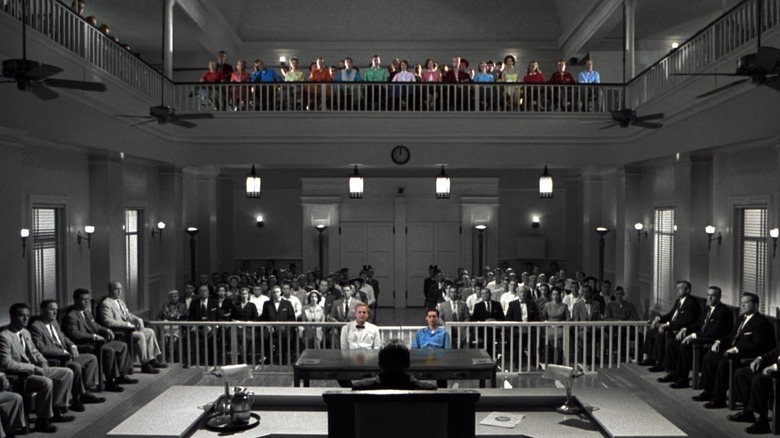
But the metaphor goes beyond mere passion. There is also a very clear racism metaphor going on. The people in Pleasantville who are exposed to passion gain color, and the people in black-and-white can tell. Prejudice erupts, and people in color are soon rejected from black-and-white businesses. There are book burnings. Trying to stay in the 1950s will lead directly to fascism. The only way forward is through progress, just as the 1950s gave way to the 1960s, when Civil Rights started to finally be taken seriously in America. "Pleasantville," by no means, says that everything was fixed by the 1960s, but it does chide audiences for idealizing the 1950s, and urges people to grow out of it. Just as black-and-white TV gave way to color, so too should black-and-white thinking become more vivid.
"Pleasantville" also starred William H. Macy as Joan Allen's square husband, and the late, great J.T. Walsh. Don Knotts played the TV repairman who handed David the magical remote control in the first place.
Sadly, "Pleasantville" was not a hit. Made for $60 million, it only earned about $48.2 million at the box office. This was despite a great deal of praise from critics; the film has an 86% approval rating on Rotten Tomatoes, based on 98 reviews. It was compared a lot to "The Truman Show." Roger Ebert gave the film four stars. It was nominated for three Academy Awards, including Best Production Design, Best Costumes, and Best Score. Sadly, it lost all three.
Gary Ross continued to make Hollywood films about rebellion against stifling systems, including "The Hunger Games" in 2012 and "Free State of Jones" in 2016. His most recent film credit was for writing the screenplay to the 2025 historical actioner "Desert Warrior" with Anthony Mackie.