

A Rogue One Actor Was Surprised By How Incomplete The Star Wars Movie's Script Was
It's an openly acknowledged fact in Hollywood that major blockbusters often have many more screenwriters than the ones that are credited. Big-budget movies often get written and re-written incessantly over the course of their production cycles, often being passed from screenwriter to screenwriter like a well-moneyed game of Telephone. Sometimes, ideas from the initial drafts are carried into later drafts, while sometimes stories are re-invented from scratch. The re-writing can often be attributed to snippy studio heads who want their blockbusters to look and feel just right, and don't have confidence that a single screenwriter can pull it off.
This isn't always the way, but it's common. Case in point: Gareth Edwards' 2016 sci-fi film "Rogue One: A Star Wars Story" had a screenplay that was credited to Tony Gilroy and Chris Weitz, but feels like a rushed mishmash of ideas rather than the vision of those two writers working together. Indeed, one will find that Gary Whitta wrote the original draft, while Weitz was only hired after the fact to re-write it. Then, after production wrapped, Gilroy was brought in to write and re-write during a five-week reshoot phase. Reports began to come out that other screenwriters — Christopher McQuarrie, Scott Z. Burns, and Michael Arndt — had all worked on the "Rogue One" script.
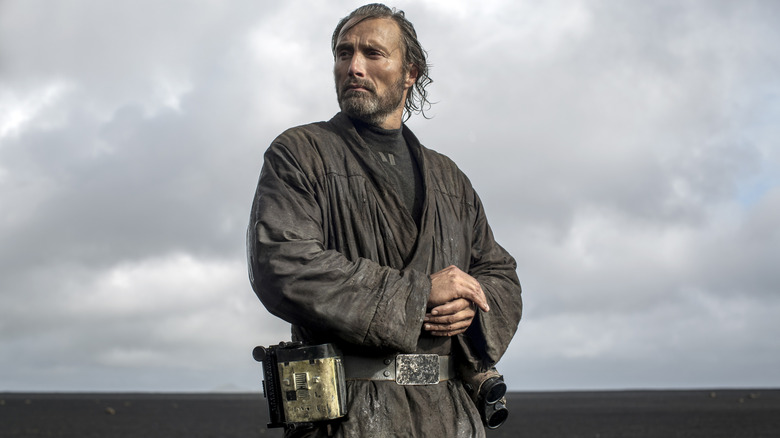
These constant re-writes have to be frustrating for an actor. They likely signed on to a major blockbuster thinking they would be shooting one script, only to find that they're getting new pages to memorize all throughout production. This was certainly the case with Mads Mikkelsen, who played the space engineer Galen Erso in "Rogue One." In a recent video interview with Variety, Mikkelsen recalls arriving on set and finding that the script was most definitely unfinished.
Mads Mikkelsen found that the script to Rogue One was unfinished
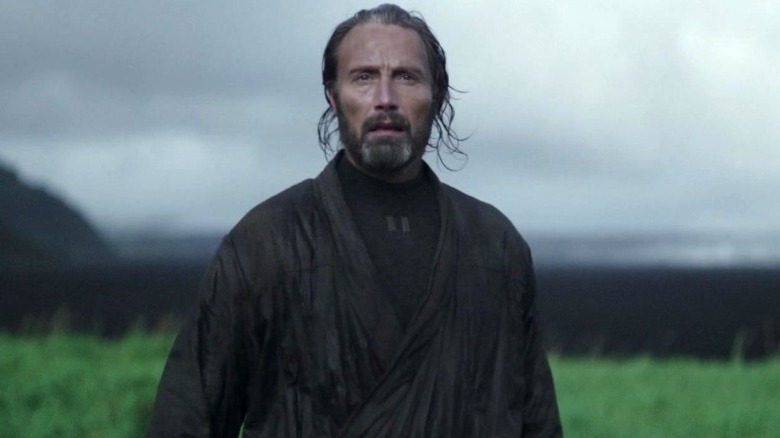
In "Rogue One," Mads Mikkelsen's character, Galen, is an architect who was forced by the evil Empire to design and oversee the construction of the Death Star. However, Galen constructed the Death Star with a deliberate flaw that would allow a daring pilot to explode the entire structure with one shot of a proton torpedo. This, of course, eventually happened in the 1977 film "Star Wars," which takes place immediately after the events of "Rogue One."
Mikkelsen signed on to play Galen with a good sense of the character. But, as he explained in the Variety interview, the screenplay wasn't even done when he arrived:
"For a 'Star Wars' film, it was surprisingly unfinished in the script. It kept changing, and one would think that was already done. I don't think they ever locked a draft. I think they kept working on it, and improvised, and went back and reshot stuff, and then came up with a better idea. [...] [It is] kind of livable for a character like mine. I mean, I had my mission. I knew what it was. But, it was obviously tricky for the two young heroes, not knowing exactly what they were carrying into a room of baggage. But I think, as I said, it turned out to be a really nice film."
Mikkelsen also said that he was physically uncomfortable on set, specifically during a scene that he shot in the rain with ice-cold water falling on his face. But he felt the film was "cute," and that he enjoyed watching it. The "two young heroes" he's referring to are Jyn Erso (Felicity Jones), Galen's daughter, and Andor (Diego Luna), who went onto have his own spinoff TV series.
The original ending for Rogue One was different
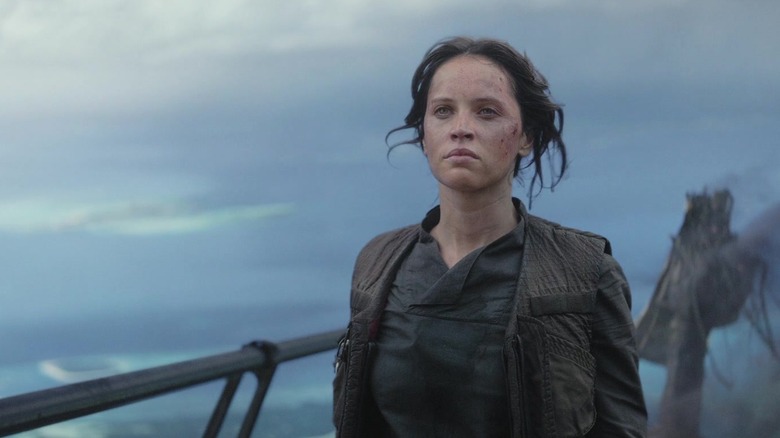
As mentioned, the ending of "Rogue One" leads directly — up to the minute — into the beginning of George Lucas' "Star Wars." The plot of "Rogue One" follows a squadron of Rebels who embark on a mission to infiltrate the Empire, steal plans for the Death Star, and bring them back to the Rebel Alliance. They were successful in their mission, but each of the main characters dies by the end. According to a 2016 interview with the Verge, however, director Gareth Edwards originally had a script that saw all of the characters live at the end. He wasn't allowed to tell an "everybody died" ending until Disney gave its express approval.
Of course, since none of the "Rogue One" characters were ever mentioned in the first "Star Wars," it made sense that they would all be killed, and Edwards seems pleased with his bum-out ending. Luckily for Mads Mikkelsen, his character is out of the story by the time the film climaxes, so he didn't have to worry about additional changes to the end.
"Rogue One" is a slick, great-looking film with high-end, convincing special effects, and excellent cinematography by Greig Fraser. The script, however, is a mess. The story isn't interesting, as it all unfolds with a tedious sense of bland fan-inspired fatalism. Also, the characters are mostly bland and one-note. It's one of the worst "Star Wars" movies. Perhaps Hollywood could learn that fewer screenwriters might be the secret to success, and not more.