

Steven Spielberg Regrets Making The First Director's Cut Of One Of His Most Important Films
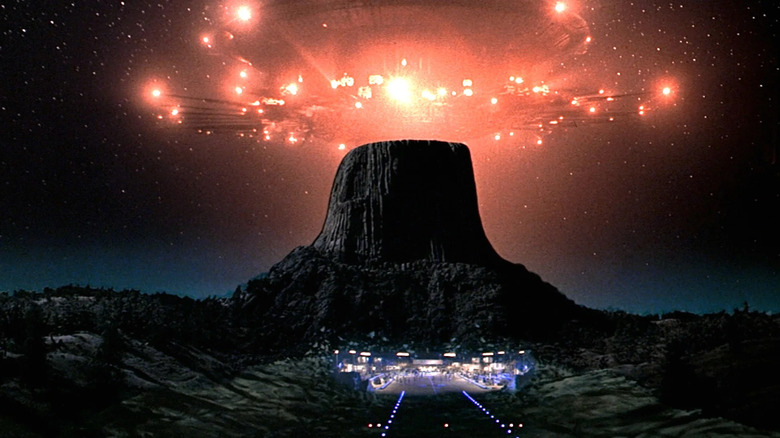
When I signed up for my degree in film studies, our tutor didn't start us off with "Citizen Kane" or "Battleship Potemkin" or anything like that. Instead, they took us to the local cinema for a special showing of "Close Encounters of the Third Kind." Seeing it up on the big screen was pure magic, especially when we got to the dazzling light show at the end. Wisely, the version shown wasn't Steven Spielberg's Director's Cut, in which he made a change to one of his most important films that he still regrets today.
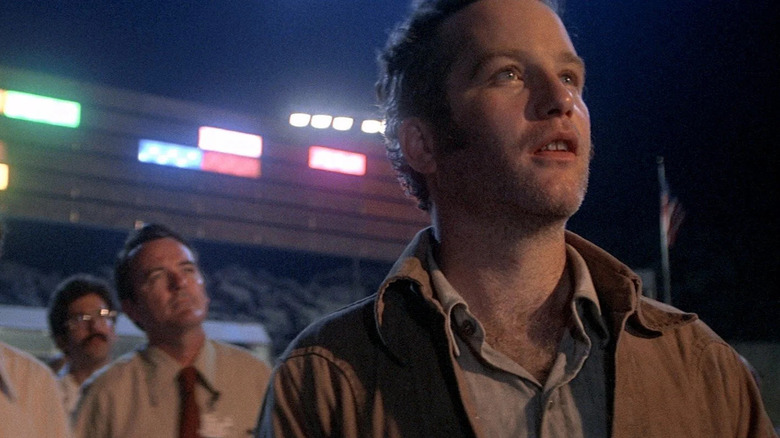
"Close Encounters" was a personal project for Spielberg. After the phenomenal box office success of "Jaws," the young filmmaker was handed the freedom to make any movie he wanted by Columbia Pictures. He returned to the subject of "Firelight," an early film he made as a teenager about mysterious UFO sightings and a CIA cover-up. Richard Dreyfuss was on board again to play Roy Neary, a blue-collar family man whose mind is altered after his own close encounter. That's just one of a spate of UFO incidents that occur worldwide in the film, including the abduction of Jillian Guller's (Melinda Dillon) three-year-old son. Thereafter, Roy and Jillian both become obsessed with the enigmatic form of a towering rocky outcrop. Once they recognize the implanted image as Devils Tower in Wyoming, they set out to make a rendezvous with the aliens despite the efforts of the U.S. government.
"Close Encounters" isn't Spielberg's strongest film narratively, and Neary isn't the most likable protagonist, but that hardly matters when the mother ship descends on Devils Tower. Cued up by John Williams' unforgettable five-note motif, the symphony of light and sound is one of the most wondrous sequences in Hollywood cinema. But Columbia wanted Spielberg to take it even further.
Columbia Pictures wanted us to see inside the mother ship in Close Encounters
Despite the freedom and financial support that Spielberg received from Columbia to make "Close Encounters of the Third Kind," there was a proviso. Although the director was looking ahead to another potential summer blockbuster, the studio had bet the farm on the picture becoming a Christmas hit and insisted on a mid-November release date.
Spielberg could hardly complain, but the tight deadline meant he had to rush the final product and skip some sequences. It didn't harm the film's commercial and critical success: "Close Encounters" made it back-to-back blockbusters for Spielberg, grossing $340 million worldwide against a $20 million budget and receiving multiple Oscar nominations. That was a great achievement in itself, but it was even more impressive for a family-friendly sci-fi movie released in the same year that "Star Wars" dominated the box office.
Having delivered another substantial hit, Spielberg went back to Columbia and requested extra funds to complete the movie as he originally intended. The studio accepted, but there was another condition: It wanted a money shot revealing the interior of the mother ship, and Spielberg was forced to make a compromise he'd come to regret.
In the original theatrical cut, Roy Neary doesn't hang about when the aliens invite him to go for a ride at the end of the film. We last see him walking up a landing ramp into the glowing light as one of the extra-terrestrials has a little sign language chat with François Truffaut's globe-trotting ufologist. Then the ship takes off, and that's it. But to keep the studio happy, Spielberg brought back Dreyfuss to give us a peek at what Neary sees inside.
Showing the interior of the mother ship didn't add much to Close Encounters
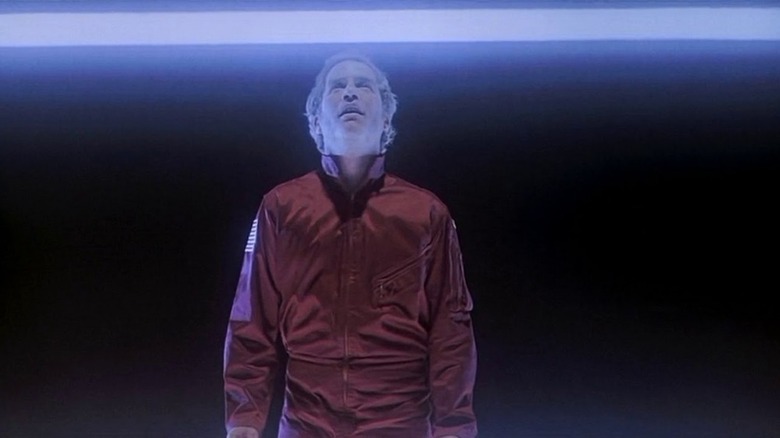
After Spielberg had made his tweaks and shot extra footage, the "Close Encounters of the Third Kind" Special Edition was released in March 1980. Curiously, for a director's cut, it's three minutes shorter than the theatrical edit; while Spielberg added new scenes to emphasize the way that Neary's family crumbles under his UFO obsession, along with another moment of spectacle with a ship found in the Gobi Desert, he also cut several scenes he didn't think worked so well.
The big showcase change was an extra scene at the end revealing the interior of the mother ship. It's totally fine; Neary gazes up as mini UFOs flit about, and we see a vast space occupied by a twinkling Christmas tree-like structure and a whole bunch of windows with tiny alien silhouettes looking out at their new passenger. Showing all this doesn't break the movie, but it also doesn't add much either. The special effects are in keeping with the exterior shots filmed a few years earlier, but it feels a bit superfluous, and Williams hits his "Wish Upon a Star" homage even harder on the nose.
Overall, it's a bit anticlimactic, and Spielberg later lamented the decision (via Far Out): "I never should have done [that], because that should have always been kept a mystery, the inside of that ship." Spielberg corrected his mistake when he returned to "Close Encounters" again for the 1998 Collector's Edition. He kept the character-building stuff and the ship in the desert, but he chopped the interior finale, giving us his definitive version of the film and restoring (for newcomers, at least) the mystery of what is inside the mother ship.