

Heathers' Original Ending Was Way Too Dark For Hollywood
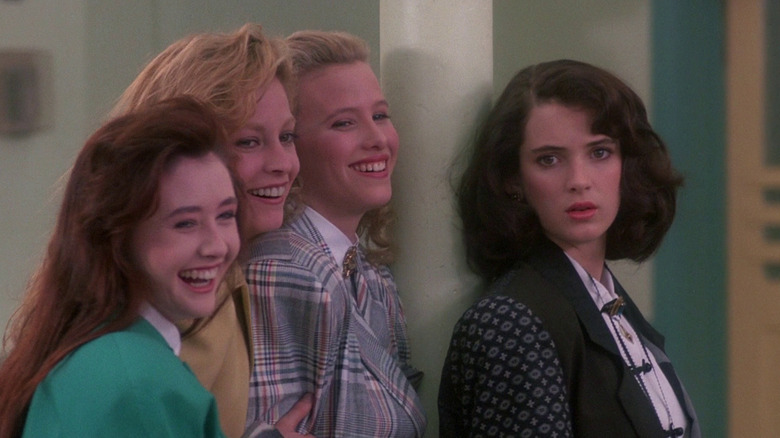
Jocks, prom queens, slackers, geeks, and rebels; '80s Hollywood was often like one big long teen movie, with even the slasher horror boom largely focused on young and horny protagonists falling victim to the killer's knife. Overall, however, teen angst was a pretty cozy place back then, as we saw in the likes of "Fast Times at Ridgemont High," John Hughes films, and the nostalgia of "Stand By Me." That changed towards the end of the decade when director Michael Lehmann murderously skewered the cliches with "Heathers," but his original ending was way too dark for Hollywood studios.
"Heathers" is set in a very middle-class fictional high school in suburban Sherwood, Ohio, where a powerful clique of girls enjoy total dominion over their fellow students. Heading up the pack is spiteful Heather Chandler (Kim Walker), backed up by her namesake lieutenants Heather Duke (Shannen Doherty) and Heather McNamara (Lisanne Falk). Their newest member is Veronica Sawyer (Winona Ryder), who goes off script when she starts dating enigmatic outsider J.D. (Christian Slater). After a fatal prank leaves Chandler poisoned on the floor, the school is swept up by teen suicide fever as the deadly couple chose their next victims.
Screenwriter Daniel Waters originally envisaged "Heathers" as a three-hour epic helmed by Stanley Kubrick, but he was forced to temper his ambitions and ended up working with first-time director Lehmann instead. The younger choice of filmmaker worked out superbly well, and the result was a merciless satire of teen fads, consumerist culture, the generation gap, and parasitic media coverage of tragic events. And it would've been even edgier if Waters and Lehmann had their way.
The original ending of Heathers went all the way
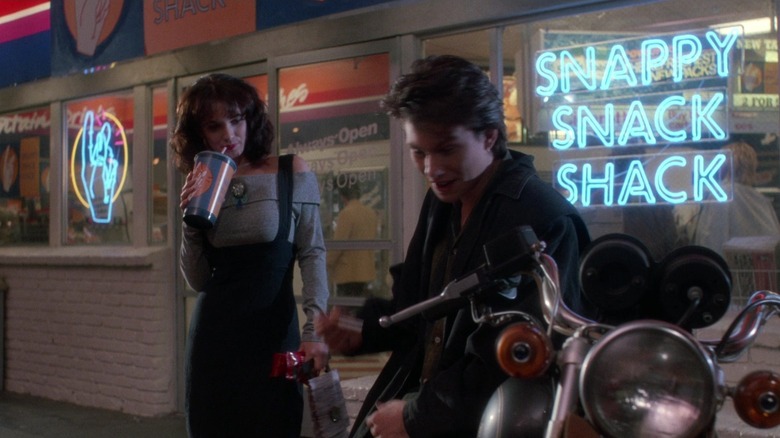
In "Heathers," Veronica finds herself becoming J.D's accomplice as they cover their tracks, using her ability to copy people's handwriting to forge suicide notes. After a few more murders dressed up in a similar fashion and the high school attracting intense media coverage, Veronica comes to her senses and realizes J.D.'s really just a horrible person. His endgame involves blowing up the entire school as his grand statement about society (or what he imagines as the "Woodstock of the '80s").
In Daniel Waters' original version of the screenplay, that's exactly what J.D. does, and the film would've concluded with all the students attending prom in Heaven. As Michael Lehmann told the audience at a 2016 screening of "Heathers" in Littleton, Colorado (via Denver Center Performing Arts):
"That was the official, actual end to the movie that we wanted to make – and we were dead-set on making it. One of the reasons this movie got made in the first place is because there was a young executive at New World Pictures named Steve White [...] He was a really good guy. He read the script, and he completely got it. He said, 'I have a mandate. I can make movies at a certain budget here. I don't need to get approval from anybody. I am going to make this movie.'"
The only thing White didn't approve of, however, was the ending. Concerned that the protagonists blowing up the school might prompt a copycat disaster, he insisted on a change. Lehmann and Waters refused and took their screenplay elsewhere, but quickly discovered that no Hollywood studio was prepared to go with their dream conclusion to the film. So, they eventually found themselves "crawling" back to New World Pictures and compromising on the ending.
The compromised ending of Heathers takes the edge off
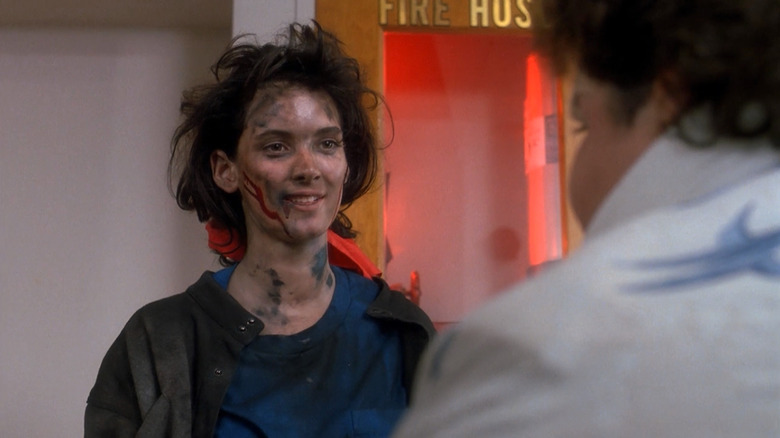
Shorn of Daniel Waters' original explosive ending to "Heathers," there is a subtle but significant change in tone to the conclusion we have now. When it becomes clear that J.D. is very serious about going through with his masterplan, Veronica sets out to stop him before it's too late. That's when the film loses much of its satirical bite and turns into a standard psycho-thriller, with the murderous loner planting home-made bombs beneath the school gym. Once thwarted, the misfit blows himself up before we get something approaching a happy ending: Veronica declares herself the new sheriff in town and invites Martha (Carrie Lynn), a former victim of the Heathers, to spend prom night with her.
This revised conclusion somewhat softens the movie, which is bracingly spiky and almost confrontational up to that point. Even so, "Heathers" still proved a little too dark for audiences, and the film flopped at the box office. In hindsight, it was probably for the best. The movie was considered pretty edgy and subversive at the time, and it feels even closer to the knuckle from a modern perspective.
J.D.'s methods of killing may vary, but it's hard not to think about Columbine and the epidemic of school shootings that have followed when you see him spouting his anti-social philosophy in his trench coat. The suicide angle also feels rather touchy; although Michael Lehmann has maintained that teen suicide wasn't intended as the focus of the satire, it's a little harder to swallow now that we're generally more sensitive towards people suffering from mental health issues that might lead them to take their own life. Blowing up the school might well have been a step too far.