

Every Knives Out Movie Is Political – Wake Up Dead Man Doubles Down
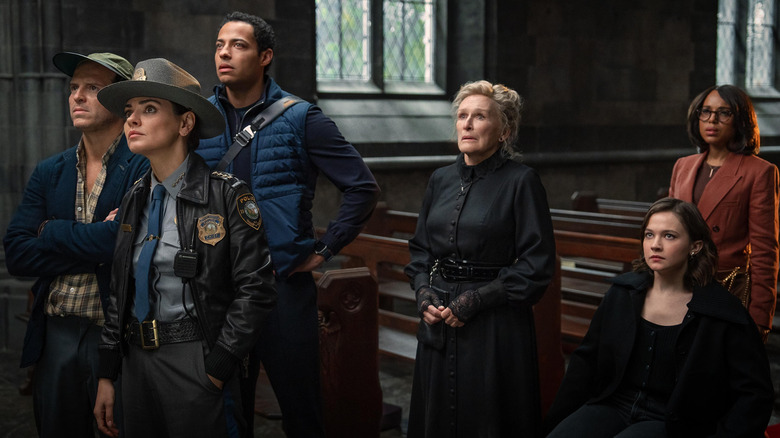
Massive spoilers follow!
Anyone who wants to pretend that writer-director Rian Johnson's series of "Knives Out" movies isn't political is fooling themselves (although, to be fair, I think that's a pretty difficult and perhaps impossible stance to defend). Johnson's work, in a broader sense, is political; his single "Star Wars" project, "The Last Jedi," is probably up there with "Andor" as one of that franchise's more overtly political outings. To that end, Johnson's third "Knives Out" movie, "Wake Up Dead Man,," which reunites him with his star Daniel Craig and assembles a phenomenal group of performers for the duo's latest murder mystery featuring master detective Benoit Blanc (Craig), is the most political one so far, and for good reason.
Before I get into it, here's a little background. 2019's surprise blockbuster and murder mystery "Knives Out" showed us the way that some people treat immigrants and view that entire system, especially as the wealthy and spoiled Thrombey family members pretended to be nice to their late father's caretaker and nurse Marta (Ana de Armas) in the aftermath of his death. Its 2022 sequel, "Glass Onion: A Knives Out Mystery," explains how tech billionaire Miles Bron (Edward Norton) screwed over all of his friends and loved ones to unethically earn his money, driving the point when Bron's glass mansion — which is housing the real Mona Lisa on loan — explodes in flames. "Wake Up Dead Man," Johnson's latest installment in this fledgling franchise, tackles religion, bigotry, and the objectively right-wing based "manosphere," and it does so explicitly and brilliantly without being gratuitous.
After two Knives Out movies, Rian Johnson is honing in on the manosphere
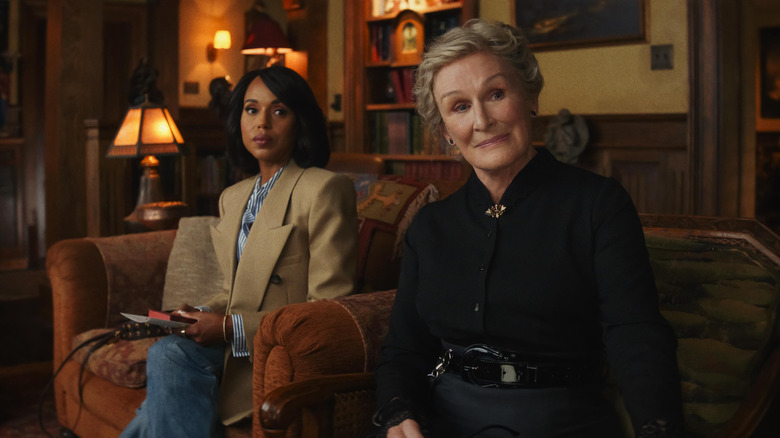
Let me start by saying that the script for "Wake Up Dead Man" is particularly good (in my own personal opinion), in that Rian Johnson is able to capture the current political climate without being too direct or, frankly, corny. He does so, in my estimation, through two specific characters: Our Lady of Perpetual Fortitude's monsignor Jefferson Wicks, played by Josh Brolin, and the man who turns out to be his illegitimate son, Cy Draven, played by Daryl McCormack. Jefferson is an odious and genuinely awful man, and one of his worst characteristics is the way that he preaches solely on a platform of hate and division.
As new reverend Jud Duplenticy (Josh O'Connor) tries to settle in at Our Lady of Perpetual Fortitude, he's understandably put off by Jefferson's increasingly bizarre confessions (which pretty exclusively focus on Jefferson's made-up incidents of masturbation, which he manufactures just to freak out Jud) and the fact that Jefferson's "flock" is utterly devoted to everything he says, no matter what. In fact, there's a whole montage of times that Jefferson tailored speeches to target newcomers, and we watch same-gender couples, single parents, and COVID-conscious people flee his church (we don't hear the sermons, but the visuals are enough).
Then there's Cy, who represents toxic masculinity at its worst. Carrying around a mounted iPhone that he uses to make tragic, beefed-up YouTube videos for the manosophere, Cy tells Jud at one point that he's an aspiring right-wing politician and has tried having opinions on everything to no avail, making it clear that he believes in nothing at all. Through Cy and Jefferson, Johnson gets his point about the modern political era across quite well.
Without ever mentioning names, Wake Up Dead Man is completely keyed into the current political climate
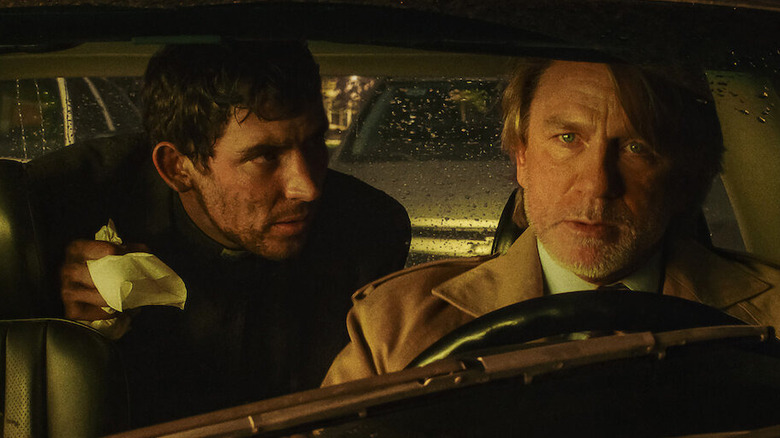
During Cy and Jud's conversation — which happens pretty early in the movie, as it's part of a sequence where Jud explains the suspects in Jefferson Wicks' mysterious murder in a letter to Benoit Blanc — Jud gently suggests that Cy find a more productive platform for his potential political career than, you know, a little bit of everything all at once. Cy responds — and I'm paraphrasing here — that maybe he could convince potential voters that people they hate will come and take away things that they love if he's able to scare them enough. Beyond that, Cy's habit of making YouTube videos centers almost exclusively around Jefferson's bombastic and apparently hate-filled sermons, and he more or less tells Jefferson that he can frighten people into following him down a dark road of hatred, bigotry, and fear of the proverbial "other."
I'm not here to editorialize. Luckily, I don't have to. Once you've seen "Wake Up Dead Man," you know the movie does that for me, and it does so without being as direct as it could be in the hands of a lesser director. (Paul Thomas Anderson's bravura "One Battle After Another" manages to pull off this same feat, honestly, and it's remarkable to me that both of these movies released within a few months of each other.) Johnson's work, as I said, is largely political in nature, and he's been particularly good at writing parables that somehow aren't irritating during deeply divided political times in the United States. He did it once again with "Wake Up Dead Man," and his message here — that hatred and resentment will only divide people further, which is why tyrants embrace it to gain power — is significant once again.