Sitting down with Robert Downey Jr. is as cool as you think it would be. The guy is smart, funny and comes off as incredibly open about, well, everything. So when a bunch of journalists got a chance to chat with the actor to discuss Iron Man 3, he gave us loads of information. How is Tony feeling post Avengers? Will there be an Iron Man 4 and how is Downey feeling at the end of his Marvel contract? Does he prefer being part of an ensemble or the lead? What kind of impact has Joss Whedon had on Phase 2? How is Iron Man 3 director Shane Black versus Iron Man 1 and 2 director Jon Favreau?
Downey Jr. brings up his own expectations for Iron Man 3, Oliver Stone and much more. It’s a fun, light read with the star of one of the biggest franchises on the planet. Read it below. Read More »
.
Please Recommend /Film on Facebook

Both Shane Black and Kevin Feige know how important Iron Man 3 is. Not only is it a sequel to two successful Iron Man films, it’s a sequel to one of the biggest movies of all time, The Avengers, and the first prequel to a slew of other films, such as The Avengers 2 and Guardians of the Galaxy. That meant lots and lots of care was taken in preparing not only the script, but the connections within the Marvel Cinematic Universe as well as balancing the action in regards to the other films.
A few months ago, we were among a group of journalists who sat down with Black and Feige to discuss all those things related to Iron Man 3, and more. Below, you can read quotes about the development, filming and context of Iron Man 3 as well as the mystery of post-credits sequences, Black Panther, Runaways, the S.H.I.E.L.D. TV show and PG-13 vs. R-ratings. Read More »

With so many horror sequels and demon possession films released year after year, a demon possession horror sequel doesn’t sound like the freshest idea. That’s where Eli Roth comes in.
A noted writer and director in his own right (and an actor, too), Roth produced the upcoming The Last Exorcism Part 2, a sequel to the surprise 2010 hit film, with those pitfalls in mind. He’s well aware the film has a mountain to climb. It’s a possession film, and a horror sequel. It has to live up to expectations bolstered by an original movie that made over $40 million and had an ending so memorable, the sequel was all but predetermined. The task then became working off the promise of that ending and avoiding the stigmas of its genre.
After the release of the trailer for The Last Exorcism Part 2 in January, we spoke to Roth about the problems with sequels, how this movie attempts to transcend them as well as a bunch of his upcoming projects: the Netflix show Hemlock Grove, his next movie The Green Inferno and more. Check it out below. Read More »

Twenty-six letters, twenty-six directors, twenty-six ways to die. That’s the simple premise behind The ABC’s of Death, the crazy anthology horror film that is available on demand today, and will be in theaters on March 8.
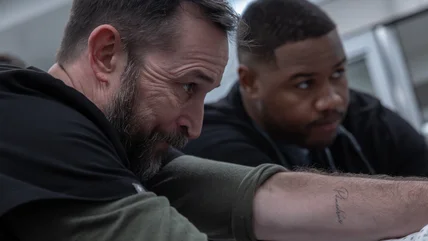
Being as today is the first day the public can see this film (which we reviewed here) twenty-six different websites are simultaneously posting interviews with all the directors. We spoke to Adam Wingard, the director of “Q,” seen above. Wingard (left) is also the director behind A Horrible Way to Die, this summer’s (awesome) release You’re Next, and segments in VHS and S-VHS.
He and creative partner Simon Barrett (right, who contributed to all those projects as well) had an unenviable task adapting the letter Q. We discussed that along with the release of You’re Next, the success of S-VHS and his upcoming Warner Bros. film Dead Spy Running. Plus, if you’ve ever wanted to know how a genre director first comprehended death, this interview has the answer, along with a list of Wingard’s favorite on-screen deaths ever.
Read More »
Posted on Friday, November 9th, 2012 by Angie Han

Director Sam Mendes and star Daniel Craig may be the big marquee names of Skyfall, but the real driving forces behind the Bond franchise have long been Barbara Broccoli and Michael G. Wilson. The half-siblings are the daughter and stepson, respectively, of late producer Albert R. “Cubby” Broccoli — the man who, along with producer Harry Saltzman, first brought Ian Fleming‘s now-iconic spy to the silver screen in 1962 — and have been involved with the series since the Roger Moore era.
At a recent Skyfall press day in New York, I got to speak with the pair about what Mendes brings to the franchise, the advantages of having Craig on board, the importance of interesting female characters, and whether perennial fan favorite Christopher Nolan might ever direct an installment. Hit the jump to read on.
Read More »

Here’s my full interview with the writers and directors of Cloud Atlas: Andy Wachowski, Lana Wachowksi and Tom Tykwer.
Last week, we broke up this long interview into four parts to make it both more digestible and to keep in spirit with the film, which comprises six radically different, but related, stories. The film jumps from story to story to story, with the last scene informing and enlightening the first, even though they’re set in totally different time periods and genres. Actors portray upwards of six roles each giving the viewer an hint of how these beings relate to each other, only to effect the others – and human history – in radical and exciting ways.
While the Wachowskis have done little to no press since the release of The Matrix, it was my honor (and horror) to be able to sit down with them, and Tykwer, for thirty minutes to discuss the movie. I was frightened, nervous, intimidated but in the end all three filmmakers not only enhanced my (immense) enjoyment of the movie, but were themselves fascinating and brilliant subjects. I wish I could have talked for an hour more.
I can’t recommend Cloud Atlas highly enough. You may not emotionally connect to it as much as I did, but it’s such a different, expertly crafted experience, you’d be doing a disservice to yourself, and big budget, risky films in the future, by not seeing it.
After the jump, read a full transcript of my interview with Tom Tykwer, Andy Wachowki and Lana Wachowski, the writers and directors of Cloud Atlas. Read More »

Editor’s Note: This is the fourth and final part of /Film’s interview with Andy Wachowski, Lana Wachowski and Tom Tykwer, the writers and directors of Cloud Atlas. Read part one here, part two here and part three here. The full interview will be published tomorrow, the day the film opens.
All of the major actors in Cloud Atlas play at least four roles. A few play as many as six. Tom Hanks, Halle Berry, Jim Broadbent, Hugo Weaving, Jim Sturgess, Ben Whishaw, Doona Bae, Hugh Grant, James D’Arcy and Keith David all have multiple personalities to portray. Some significant, others less so, and they’re not always the same race or sex as the actor in the role.
So in the film, you’ll get to see Halle Berry as an Asian man and a white German woman. Hugo Weaving is a hulking female nurse; Jim Sturgess is a Korean crime fighter; and Ben Whishaw is a loving wife. In doing this, co-writers and directors Andy Wachowski, Lana Wachowski and Tom Tykwer were able to visually display the movement and evolution of the human soul across eternity and also play against segregated acting conventions Hollywood has employed for years. They believe actors should not be pidgeonholed by their race or sex and, after the jump, the three filmmakers discuss not only that, but how the process was liberating for their actors.
After the jump, read the fourth part of my interview with the team behind Cloud Atlas. Read More »

In October of 2011, I was flown to Toronto, Canada to visit the set of Mama. Directed by Andy Muschietti (above left) and starring Jessica Chastain, the film promises to be a creepy, frightening story about two girls haunted by the ghost of their dead mother. There’s much more to that, and you can read all about it in my set visit report here. The film opens January 18.
One of the real treats of the trip, though, was getting to spend an extended time talking to Guillermo Del Toro. At the time, Del Toro was not only producing Mama, but prepping his massive 2013 film, Pacific Rim, at the same studio. That allowed him to interact with Muschietti numerous times throughout the day as each made their movie.
In our extended discussion, Del Toro talked about that relationship, what drew him to Mama, battling the MPAA, the state and evolution of the horror genre, working with new filmmakers, over extending himself across various projects (such as Haunted Mansion, Frankenstein and At the Mountain of Madness) and even some old Hollywood trivia. Fans of Del Toro will love this. Read More »

Cool Posts From Around the Web: